When federal agencies reorganize or downsize, employees often find themselves trying to decode a long list of rules, terms and procedures. Perhaps confusing, but one of the most important parts of the process is understanding how your position and grade are protected when a Reduction in Force (RIF) happens. This is where the concept of Bump and Retreat comes in.
Although it might not sound pleasant, it is very important in deciding what happens in the event that you lose your job. Many workers are unaware that they may be able to change jobs or even go back to a previous role rather than being fired right away.
So, let’s find out what RIF means, how it works practically and where Bump and Retreat features fit into it.
What Is a RIF and Why Does the “Bump/Retreat” Concept Matter?
After a federal agency’s reorganization or downsizing, or even when it offers voluntary retirements, it might resort to a Reduction in Force (RIF) as a last resort. RIF is not for the firing of bad employees or for bad conduct; rather, it is a mechanism that is dictated by organizational considerations (e.g., less work, less money, fewer positions).
In this uncertain time, a lot of workers are thinking that they will lose their jobs or will be demoted automatically. However, there are some protections in place. One of them is the term bump/retreat, which allows the affected workers to have the right to take over other roles instead of just being laid off.
Once you know how bump and retreat works in a reduction-in-force operation, then you can deal with the process by means of a planned way rather than panic.
Key Ideas: Assignment Rights, Retention, and Competitive Area
A RIF must specify particular structural components before federal reassignment rights, like bump/retreat, can occur:
Competitive Area & Competitive Level:
The “competitive area” is the pool (often defined by agency, function, or geography) within which employees compete under an RIF. The “competitive level” refers to the subset of positions within that area that are comparable, for example, by series, grade, or function. Here’s all you need to know about competitive area and bump rights:
Retention Register
Agencies must rank employees in each competitive level by certain criteria. This ranking helps decide who stays, who moves, and who loses out.
Standing on the Register
Your position on the retention register depends on several factors:
- Career (Group I) employees outrank career-conditional (Group II), who outrank temporary/excepted/term (Group III).
- Veterans’ preference: Within each group, veterans (especially preference-eligible) typically have higher standing.
- Service computation/length of service: More years (with adjustments for prior performance) give stronger protection.
- Performance ratings: Having a current and acceptable performance rating (for example, “Minimally Successful” or better) is often required to qualify for bump or retreat rights.
If your federal retention standing is low based on these criteria, your risk of being released is higher. But even if released from your competitive level, that does not always mean termination. This is where assignment rights come to play.
Read Also: How Many Paychecks in 2026? Complete Payroll Calendar Guide
How “Bump” Actually Works
If you are released from your competitive level because your position is abolished, you might get the right to bump someone else, however, only under certain circumstances.
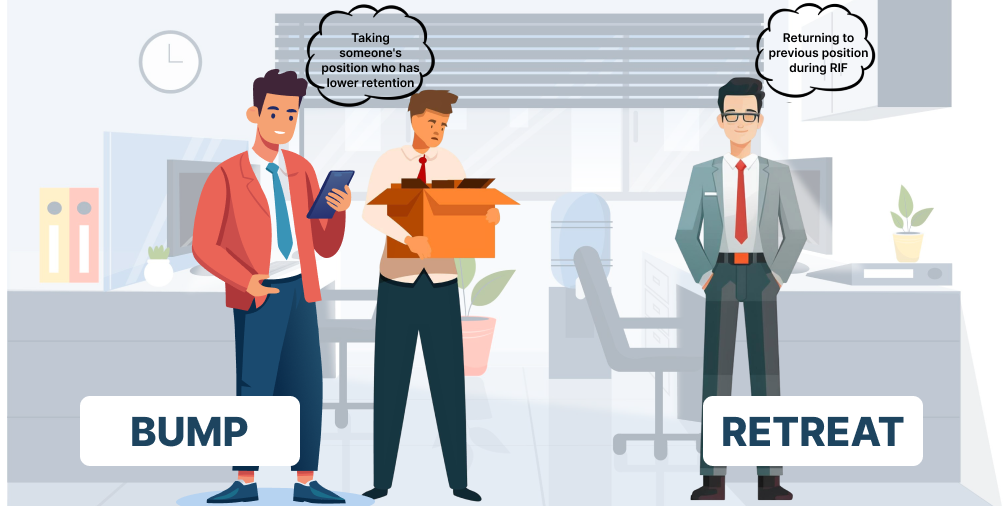
- Bumping means you displace an employee in your competitive area who has low retention standing (for example, a lower tenure group or a lower subgroup within your group), and who occupies a position of the same or lower grade (or grade intervals) than yours.
- The position you bump into doesn’t have to be vacant; you may displace the occupant. But the position must be within the allowable grade limit (usually up to three grades or grade intervals down).
- More importantly, bumping only applies within the competitive area. You cannot bump someone outside that area.
- Also, the agency must determine that you are qualified for the role you are bumping into. In some cases, qualifications may be waived for vacant jobs, but for occupied positions, the standard qualifications apply.
So if you have strong retention standing, bumping can mean you avoid separation and effectively keep working, maybe at a lower grade.
What Retreat Means: A Second Chance
If bumping someone does not work or no suitable lower-grade positions are available, there is another safety net: retreat.
- This means that you take a job that you previously held (or one mostly identical) in the same agency and competitive area, at a lower grade, if that job is held by someone with lower retention standing.
- For most employees, retreat is limited to positions no more than three grades (or intervals) below their current position.
- However, there is a special allowance for disabled veterans (preference-eligible, subgroup AD): they may be promoted up to five grades lower than their current job.
- There’s also a caveat: to be eligible for bump or retreat, you must have a current performance rating that is at least “Minimally Successful” (or equivalent). A poor rating (unsatisfactory) usually disqualifies you.
Simply put, a retreat gives a kind of fallback: if you can’t stay at your old or equivalent grade, you might remain in federal service at a lower grade rather than face separation.
Why Understanding Bump and Retreat is Vital?
If you are a federal employee, and you hear of impending reductions, be it budget cuts, reorganization, or abolishment of portions, these rights could be a lifeline. Here is why you should pay attention:
- It’s not simply about who remains. The bump/retreat process may let you avoid separation even if your position is cut. That means job continuity, less stress, and fewer disruptions.
- It gives you a strategic window: instead of panicking, you can review your own record: service-computation date for RIF, performance ratings, past roles you held (potential for retreat), and possible job slots you might bump or retreat into.
- It matters for pay grade and stability: even if you get bumped or retreat to a lower grade, you potentially retain pay protections under grade-retention rules (in many cases, under federal regulations, demotions in pay/grade may carry pay retention for a period).
- It protects veterans and longer-service employees: the system is designed to give preference to those with longer service or a veteran’s background, so in theory, bump/retreat works to preserve institutional knowledge, fairness, and experience.
In times of uncertainty, knowledge is power, and these rights are one of the most important pieces that can save you when you need it the most.
Read Also: 401(a), 401(k), 403(b): A Simple Guide to Retirement Plans
Why Bump and Retreat is a Smart Safety Net
The notion of bump and retreat might feel scary; the concept of “losing your grade” or “downgrading” is not a nice one. But when federal agencies are reduced in size, some sacrifices may be unavoidable. The bump/retreat process provides agencies more flexibility and employees a cushion, a chance to keep working and maintain some pay or benefits, rather than facing immediate separation.
Additionally, in the interests of keeping the memory and fairness in the institution, the system also places more senior and/or longer serving or preference eligible employees higher up the retention order. That’s true, especially in large bureaucracies with various specialized functions; if they were to lose all their seasoned staff in one fell swoop, they’d be crippled.
For a lot of federal employees worried about their futures, bump and retreat isn’t just jargon: It’s job security, a second chance, and in some cases, it is a lifeline.
Closing Thoughts
Experiencing a RIF is stressful. Just the thought of being laid off, losing your job, or being demoted makes people nervous and anxious. However, the system of RIF procedures for federal employees, including bump/retreat rights and other protections under the broader framework of Federal RIF rules and RIF grade protections, affords some real protection.
If you know where you stand, how much tenure you have, what your performance rating is, what your service date is, and what jobs you’re qualified for may help you weather the storm. Bump and Retreat does not necessarily mean that you will be able to keep your current job or grade, but it does provide you with the opportunity to remain with your agency, keep a job, and continue your professional life.