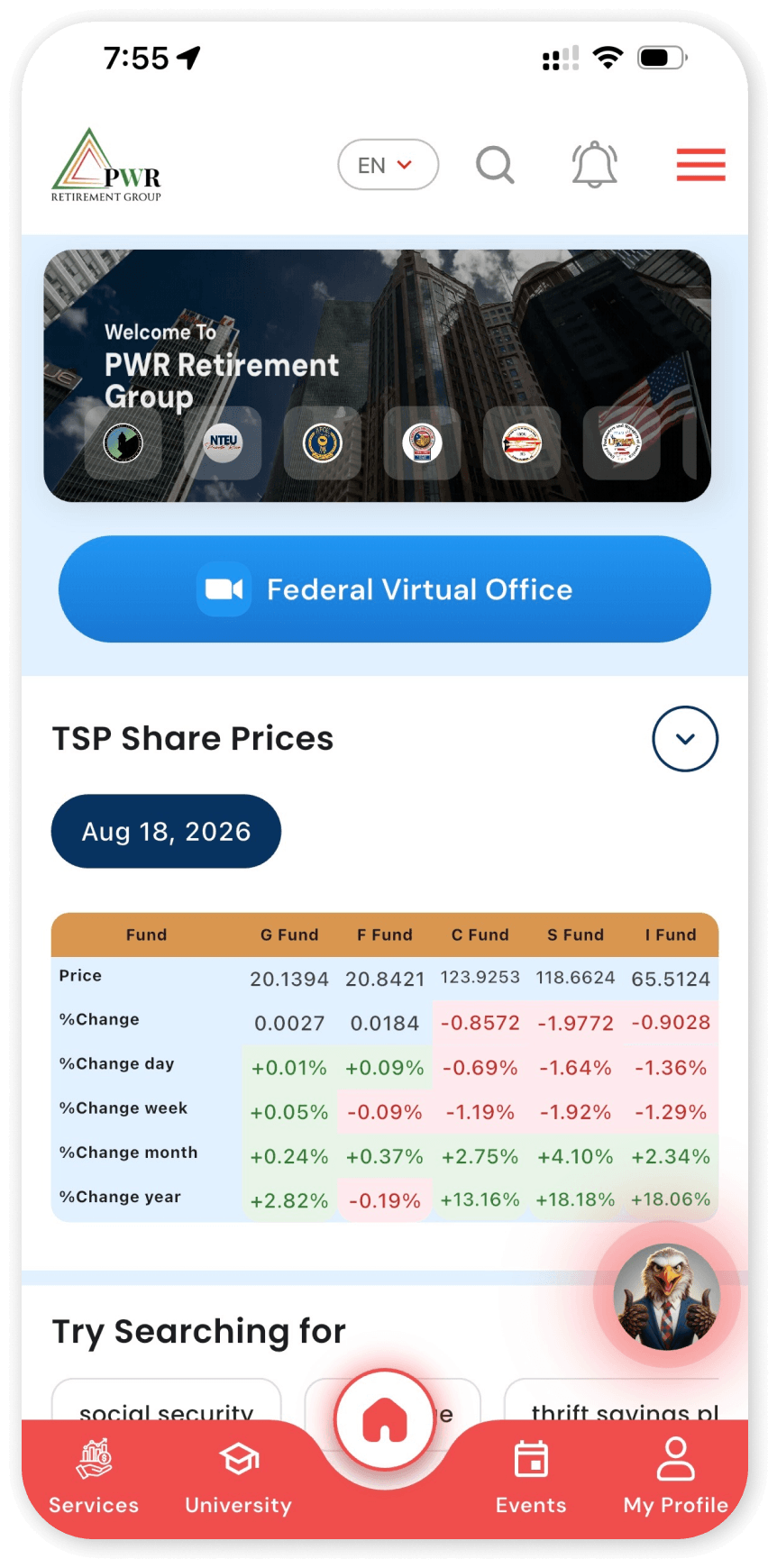






The Thrift Savings Plan is one of the most powerful retirement savings tools available to federal employees. Low costs, automatic payroll deductions, agency matching — when it comes to building wealth during your federal career, very few plans come close. And if you’ve been watching your TSP performance over the years, you already know how well a disciplined contribution strategy pays off over time.
But here’s the thing nobody talks about enough: the TSP was designed for accumulation — not distribution.
Once you retire, the rules shift. The very structure that made the TSP so efficient for growing your balance can start working against you when you need flexibility, tax control, and estate planning options. For federal employees and retirees in Puerto Rico — where federal and local tax dynamics intersect in important ways — understanding these restrictions isn’t just useful, It could help you save thousands of dollars throughout your retirement years.
Let’s break down the 6 most significant things the TSP restricts that an IRA makes surprisingly easy.
Why Does the TSP vs. IRA Comparison Matter So Much After Retirement?
During your working years, the TSP’s simplicity is a feature. You pick a fund allocation, contribute consistently, and let TSP performance history do the heavy lifting. The G Fund, C Fund, S Fund — these are battle-tested options with rock-bottom costs. In fact, the TSP’s administrative expense ratio sits at approximately 0.066%, compared to the average actively managed mutual fund expense ratio of 0.5% to over 1%.
That cost advantage is real and meaningful. But cost efficiency alone doesn’t determine which vehicle serves you better in retirement. When income planning, tax strategy, charitable giving, and wealth transfer enter the picture, the IRA’s flexibility starts to pull ahead in ways that directly affect your bottom line — especially for federal retirees navigating Puerto Rico’s unique tax environment.
Restriction #1: How Does TSP Limit Your Withdrawal Options Compared to an IRA?
This is one of the most practical and frustrating TSP limitations retirees encounter. The TSP offers a defined set of withdrawal structures: a single lump-sum payment, fixed monthly payments, a TSP life annuity, or some combination of these. What it doesn’t offer is the ability to take an ad-hoc, one-time partial withdrawal whenever a financial need arises.
Think about what retirement actually looks like. One year you might need $8,000 for a home repair. The next, you might want to take a larger distribution to cover a medical expense. With an IRA, you withdraw exactly what you need, when you need it — no rigid structure required, and no forced changes to your ongoing payment elections.
For federal retirees in Puerto Rico who are managing cash flow across multiple income sources — FERS annuity, Social Security, and TSP withdrawals — this lack of on-demand access creates real budgeting friction. An IRA puts that control squarely back in your hands.
Restriction #2: Can You Do a Qualified Charitable Distribution (QCD) From a TSP?
The short answer is no — and for charitably inclined federal retirees, this is one of the most costly TSP restrictions there is.
A Qualified Charitable Distribution (QCD) allows IRA holders who are age 70½ or older to transfer up to $105,000 per year directly from their IRA to a qualified charity. That distribution counts toward satisfying your Required Minimum Distribution (RMD) — but it never appears in your taxable income. That means zero federal income tax on that amount.
The TSP does not allow QCDs. Every dollar of your TSP RMD is taxed as ordinary income, period. For a federal retiree with a $25,000 annual RMD who donates generously to their church, university, or local Puerto Rico nonprofit — the tax difference between a TSP and an IRA can be staggering over time.
If charitable giving is part of your retirement lifestyle, this single restriction is worth a serious conversation with your advisor. This is exactly the kind of planning detail where a Request for Consultation with a FERS-specialized financial professional can reveal thousands in annual tax savings you didn’t know you were missing.
Restriction #3: Does the TSP Offer Enough Investment Options for Retirement Income Planning?
The TSP’s five core funds — G, F, C, S, and I — plus the Lifecycle funds are excellent during the growth phase of your career. Long-term TSP performance history across the C Fund and S Fund especially has been strong, tracking broad U.S. equity markets over decades.
But retirement income planning is a different discipline. In retirement, you often need tools like dividend-focused equity strategies, REIT exposure, bond laddering, international small-cap diversification, and sector-specific positioning — none of which are available inside the TSP.
An IRA opens the door to thousands of mutual funds, ETFs, individual stocks, bonds, and income-generating assets that simply don’t exist within the TSP’s structure. For retirees in Puerto Rico seeking to build a diversified, income-producing portfolio tailored to their specific cash flow needs and risk tolerance, this flexibility gap between TSP and IRA is significant.
Read More : 4 TSP Withdrawal Mistakes You Should Never Make
Restriction #4: What Are the TSP Beneficiary Rules — and How Do They Compare to an IRA?
This is an area where the TSP’s limitations can create serious problems for federal employees with complex family situations — blended families, minor children, special needs dependents, or significant estates.
The TSP has relatively rigid beneficiary designation rules. Non-spouse beneficiaries who inherit a TSP account typically receive the balance paid out on a compressed timeline, limiting their ability to manage the tax impact strategically. In contrast, IRAs offer significantly more estate planning flexibility — including the ability to name a properly structured trust as beneficiary, utilize conduit or accumulation trust strategies, and provide more nuanced payout options for beneficiaries with special circumstances.
For federal employees in Puerto Rico who want to ensure that their retirement savings transfer to heirs as efficiently and tax-favorably as possible, relying solely on TSP beneficiary designations without exploring IRA-based alternatives can result in an unnecessarily large tax burden for the people you’re trying to protect.
#5: Why Can’t You Do a Roth Conversion Restriction Inside the TSP?
This is one of the most powerful retirement tax planning strategies that the TSP simply does not support. In-plan Roth conversions — available in many private-sector 401(k) plans — allow you to convert pre-tax funds to Roth funds without leaving the plan. The TSP has no such option.
If you want to convert any portion of your Traditional TSP balance to Roth, the only path is a rollover to a Roth IRA — a taxable event in the year of conversion, but one that can dramatically reduce your lifetime tax burden if done strategically.
Here’s why this matters so much: many FERS employees retire in their late 50s or early 60s, before Social Security begins and before RMDs kick in. That window — sometimes five to ten years of relatively lower taxable income — is a golden opportunity for Roth conversions. Converting in stages during those low-income years can shrink your future RMD obligations, reduce Medicare IRMAA surcharge risk, and leave tax-free assets for your beneficiaries.
Staying in the TSP means that window closes without you ever having the option to use it. For federal retirees in Puerto Rico, where thoughtful tax planning can meaningfully reduce your overall liability, missing this conversion opportunity is one of the most financially significant TSP restrictions of all. This is another scenario where submitting a Request for Consultation with a knowledgeable advisor can make a measurable difference in your retirement outcome.
Restriction #6: Does the TSP Cover the Same Penalty-Free Withdrawal Exceptions as an IRA?
The IRS has carved out a meaningful list of situations where IRA owners can take early withdrawals (before age 59½) without the standard 10% penalty. These include:
- First-time home purchase (up to $10,000 lifetime)
- Qualified higher education expenses
- Health insurance premiums while unemployed
- Permanent disability
- Substantially Equal Periodic Payments (72(t) distributions)
- Unreimbursed medical expenses exceeding a threshold
The TSP’s hardship withdrawal provisions are considerably narrower — requiring documented financial hardship and offering fewer qualifying categories. For federal employees who retire early under FERS (many retire in their mid-to-late 50s under MRA provisions), the ability to access funds before 59½ without penalty is not a theoretical concern — it’s a real and practical retirement income need. The IRA’s broader exceptions provide a meaningful safety net the TSP cannot match.
Should You Roll Over Your TSP to an IRA After Retirement?
This question doesn’t have a universal answer — and anyone who tells you otherwise isn’t giving you the full picture.
The TSP has genuine, lasting strengths. The expense ratios are unmatched. The G Fund offers unique capital preservation that doesn’t exist anywhere in the IRA universe. And the simplicity of a single, well-managed account has real value for retirees who don’t want to manage complexity.
But the six restrictions above — withdrawal inflexibility, no QCDs, limited investment options, rigid beneficiary rules, no Roth conversion path, and narrower penalty exceptions — represent real costs. Not hypothetical ones. For federal retirees in Puerto Rico whose financial picture involves charitable giving, estate planning, early retirement income needs, or Roth conversion opportunities, those costs add up in ways that easily outweigh the TSP’s expense advantage.
The right decision depends entirely on your situation: your account balance, your tax bracket, your family structure, your income sources, and your goals.
Read More : What Happens to Your TSP When You Retire?
FAQ — Common Questions About TSP RMDs
Q: What can an IRA do that a TSP account cannot? A: IRAs offer Qualified Charitable Distributions, in-plan Roth conversions, broader investment options, more flexible beneficiary designations, ad-hoc partial withdrawals, and more penalty-free early withdrawal exceptions than the TSP.
Q: Can you do a Qualified Charitable Distribution (QCD) from a TSP? A: No. QCDs are only available from IRAs. TSP distributions are always counted as taxable income, even if donated to charity.
Q: Can I do a Roth conversion inside the TSP? A: No. The TSP does not support in-plan Roth conversions. To convert traditional TSP funds to Roth, you must roll them over to a Roth IRA outside the TSP.
Q: What are the TSP withdrawal restrictions after retirement? A: TSP withdrawals are limited to structured options: a single payment, monthly installments, a life annuity, or a combination. Ad-hoc partial withdrawals are not available the way they are in an IRA.
Q: Should I roll over my TSP to an IRA when I retire? A: It depends on your goals. If you have charitable giving plans, estate planning needs, early retirement income requirements, or want to pursue Roth conversion strategies, an IRA rollover may offer significant advantages — despite the TSP’s lower expense ratios.
Conclusion
The TSP is a world-class savings vehicle. Its performance history speaks for itself, and it will continue to be an excellent accumulation tool for the next generation of federal employees building their careers. But retirement planning is about more than accumulation — it’s about strategic distribution, tax efficiency, and protecting what you’ve built.
Understanding the full scope of tsp distribution rules — and where they fall short compared to IRA options — is one of the most important steps any federal retiree in Puerto Rico can take. The goal isn’t to move money for the sake of moving it. The goal is to make sure the rules governing your retirement savings are working for you, not against you.
Talk to a financial advisor who understands both federal benefits and the specific tax landscape for retirees in Puerto Rico. The conversation might be the most valuable one you have this year.
Disclaimer: The information provided on this website and mobile application is for general educational and informational purposes only and does not constitute financial, investment, tax, legal, or retirement advice. PWR Retirement Group is an independent organization and is not affiliated with, endorsed by, or acting on behalf of any labor union, government agency, or employer. Users should consult an appropriately licensed financial professional, tax professional, or attorney regarding their individual circumstances before making financial, tax, legal, or retirement-related decisions.
PWR Retirement Group is an independent financial education firm and is not affiliated with, endorsed by, or sponsored by any federal agency, federal organization, government entity, or union.