






Most federal employees sign up for life insurance during their first week on the job, somewhere between the badge photo and the parking permit. Then they don’t think about it again for twenty years. That’s understandable, but it’s also where costly surprises begin. Federal life insurance is one of the most valuable parts of your benefits package, and it’s also one of the most misunderstood, especially as retirement gets closer.
This guide is a practical Financial Guide to how the Federal Employees’ Group Life Insurance (FEGLI) program works, what changes when you leave federal service, and how to think about protection that lasts as long as your family needs it.
What Federal Life Insurance Actually Gives You
FEGLI is a group term life insurance program for federal civilian employees, and it’s built in layers.
Basic coverage is the foundation. Your Basic Insurance Amount equals your annual basic pay rounded up to the next $1,000, plus $2,000. Employees age 35 and younger also receive an “extra benefit” that doubles the payout, tapering down until it disappears at age 45. The government pays about one-third of the Basic premium, and you pay the rest through payroll.
Illustrative example: Maria, a GS-12 in San Juan earning $84,350, has a Basic Insurance Amount of $87,000 ($85,000 + $2,000).
Building Your Coverage Layer by Layer
On top of Basic, three optional coverages let you customize protection. You pay the full cost of each.
- Option A (Standard): A flat $10,000 of additional coverage.
- Option B (Additional): One to five multiples of your rounded annual pay. If Maria elects three multiples, that adds $255,000 (illustrative).
- Option C (Family): Coverage on a spouse ($5,000 per multiple) and eligible children ($2,500 per multiple), up to five multiples.
Stacked together, these options can create meaningful protection during working years. The real question is what happens to those layers later.
The Age Curve Nobody Mentions at Orientation
Optional FEGLI premiums are based on age bands that reset every five years. In your 30s and 40s, Option B can feel inexpensive. By your late 50s and 60s, the same coverage can cost many times more per pay period. Many employees only notice when a birthday triggers a jump in their deduction.
This isn’t a flaw in the program; it reflects how group term insurance is priced. But it does mean the coverage that made sense at 38 deserves a fresh look at 55.
The Retirement Moment: What Happens to FEGLI When You Leave
Here’s where planning matters most. To carry FEGLI into retirement, you generally must be retiring on an immediate retirement benefit and have been insured for the five years of service immediately before you retire (or for all periods you were eligible, if less than five years).
At retirement, you make elections that are difficult or impossible to undo:
- Basic, 75% reduction: Premiums stop at 65, and coverage then reduces 2% per month until it reaches 25% of its original value. Maria’s $87,000 would eventually become $21,750 (illustrative).
- Basic, 50% or No Reduction: Coverage holds at a higher level, but you keep paying premiums for life.
- Option B: You can elect full reduction (coverage phases out over 50 months after 65) or no reduction (premiums continue at age-based rates).
The takeaway: the coverage you had while working is rarely the coverage you’ll have at 75. Knowing that early gives you time to plan around it.
Veterans and Military Service: Where SGLI and VGLI Fit
Many federal employees are also veterans. Servicemembers’ Group Life Insurance (SGLI) generally ends 120 days after separation, and Veterans’ Group Life Insurance (VGLI) offers a conversion window afterward. Applying within the initial window typically avoids health questions. If you hold both VGLI and FEGLI, it’s worth reviewing how they work together, since each has its own cost structure and rules.
Beyond FEGLI: Long-Term Strategies for Lasting Protection
For many families, FEGLI is an excellent starting point but not a complete plan. Longer-term planning often looks at:
- Private permanent coverage, such as indexed universal life, which can provide lifelong protection and potential cash value accumulation linked to a market index, subject to caps, floors, fees, and policy terms. It isn’t right for everyone, and it requires careful review.
- Beneficiary and estate structure, including trusts (fideicomisos in Puerto Rico), to help coordinate how and when benefits reach loved ones.
- Integrated income planning, so life insurance decisions align with your TSP, Social Security, and overall federal retirement benefit picture.
The right mix depends on your health, family, goals, and timeline, which is why personalized Federal Benefit Guidance matters.
FED 360: Where Your Questions Finally Get Answered
The Questions That Keep You Up at Night
It usually starts quietly: if something happened to me tomorrow, would my family be okay? Then the follow-ups arrive. Does my FEGLI coverage follow me into retirement, or does it shrink? Why did my Option B deduction jump after my last birthday? Did I ever update the beneficiary form I signed fifteen years ago? Most federal employees carry these questions for years because there’s never a clear moment, or a trusted room, to ask them.
A Room Built for Real Answers
FED 360, the Federal Retirement Guidance Summit presented by AFGE Local 2614 in collaboration with PWR Retirement Group, was created to be that room. Benefits specialists walk you through Federal Life Insurance, Thrift Savings Plan, TSP distribution options, disability retirement benefits, retirement calculators, and the ORA portal, one step at a time. The open Q&A format lets you bring the exact questions you’ve been carrying and leave with clearer next steps. It’s practical Federal Benefit Guidance, not a sales pitch, so decisions about your federal retirement benefit come from understanding rather than guesswork.
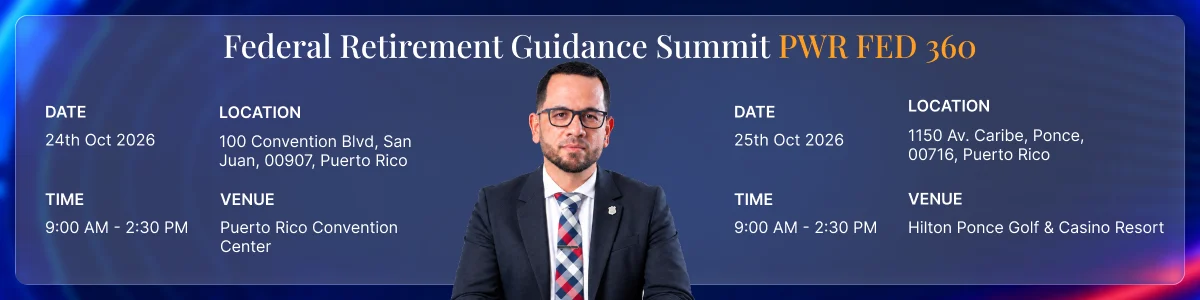
Two Days, Two Locations
- Saturday, October 24, 2026: Puerto Rico Convention Center, 100 Convention Blvd, San Juan, PR 00907
- Sunday, October 25, 2026: Hilton Ponce Golf & Casino Resort, 1150 Av. Caribe, Ponce, PR 00716
Both days run from 9:00 AM to 2:30 PM, with doors opening at 8:30 AM.
Free, Bilingual, and Open to You
Attendance is free, and lunch is included for all registered attendees. Sessions are presented in English and Spanish, so no one has to translate their own future in their head. Seats are limited at both locations, so reserve yours early.
Frequently Asked Questions
1. Does my FEGLI coverage continue after I retire?
It can, if you retire on an immediate retirement benefit and meet the five-year coverage requirement. You’ll choose reduction elections at retirement that shape your coverage for life.
2. What is the FEGLI five-year rule?
You generally must have been insured under each coverage you want to keep for the five years of service immediately before retirement, or for all periods you were eligible if that’s less than five years. OPM determines eligibility.
3. Why does my Option B premium keep increasing?
Optional premiums rise in five-year age bands. Increases become steeper after age 50, so reviewing Option B periodically is a smart habit.
4. Can I enroll in or increase FEGLI outside an open season?
Yes, in certain cases. Qualifying life events such as marriage or the birth of a child open a 60-day window for some changes, and you can apply at any time by providing proof of insurability.
5. Is FEGLI enough life insurance for my family?
It depends on your income, debts, dependents, and goals. FEGLI is a strong base, but coverage that reduces or becomes costly later may leave gaps worth planning for.
6. What happens to FEGLI if I leave federal service before retirement?
Coverage generally continues for 31 days after separation, during which you may convert to an individual policy without a medical exam.
7. What life insurance options do veterans have after separation?
SGLI typically ends 120 days after separation. VGLI offers a conversion path, and applying within the initial window usually avoids health questions.
8. How do I make sure the right people receive my benefit?
FEGLI pays according to your beneficiary designation (SF 2823) or the legal order of precedence, not your will. Review your designation after major life events, and consider how trusts or fideicomisos fit your estate plan.
Disclaimer: The information provided on this website and mobile application is for general educational and informational purposes only and does not constitute financial, investment, tax, legal, or retirement advice. PWR Retirement Group is an independent organization and is not affiliated with, endorsed by, or acting on behalf of any labor union, government agency, or employer. Users should consult an appropriately licensed financial professional, tax professional, or attorney regarding their individual circumstances before making financial, tax, legal, or retirement-related decisions.
PWR Retirement Group is an independent financial education firm and is not affiliated with, endorsed by, or sponsored by any federal agency, federal organization, government entity, or union.