


Additional retirement savings for those who also work for themselves.

An educational guide for federal employees, retirees and their families in Puerto Rico and across the U.S. Learn how a Keogh plan works, who may qualify, and how it fits alongside your TSP and FERS/CSRS.

Get your educational session

No cost. A PWR educator will reach out to talk through your situation.

"*" indicates required fields

Veteran*

Educational information only. Not legal or tax advice.

Get your educational session

No cost. A PWR educator will reach out to talk through your situation.

"*" indicates required fields

Veteran*

Educational information only. Not legal or tax advice.

The Presentation

Walk through the full Keogh presentation

Browse PWR’s educational presentation slide by slide, or download it to review later.

The Basics

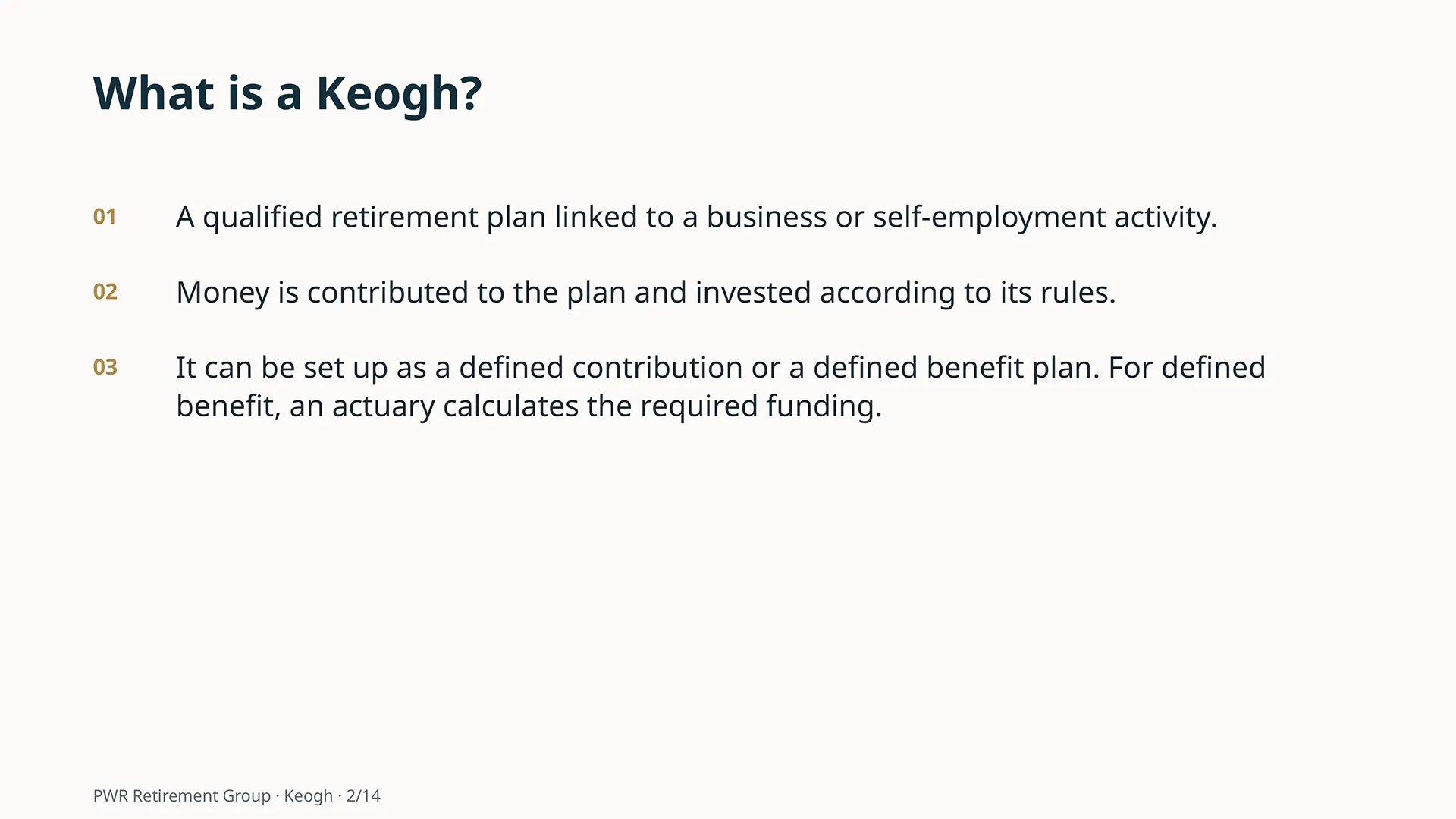
What is a Keogh plan?

A qualified retirement plan for people with self-employment or business income, built around three core ideas.

01

Tied to a business

It is a qualified retirement plan linked to a business or self-employment activity.

02

Contributed and invested

Money is contributed to the plan and invested according to the plan’s rules.

03

Two possible designs

It can be set up as a defined contribution or a defined benefit plan. For defined benefit, an actuary calculates the required funding.

Eligibility

Does it apply to a federal employee?

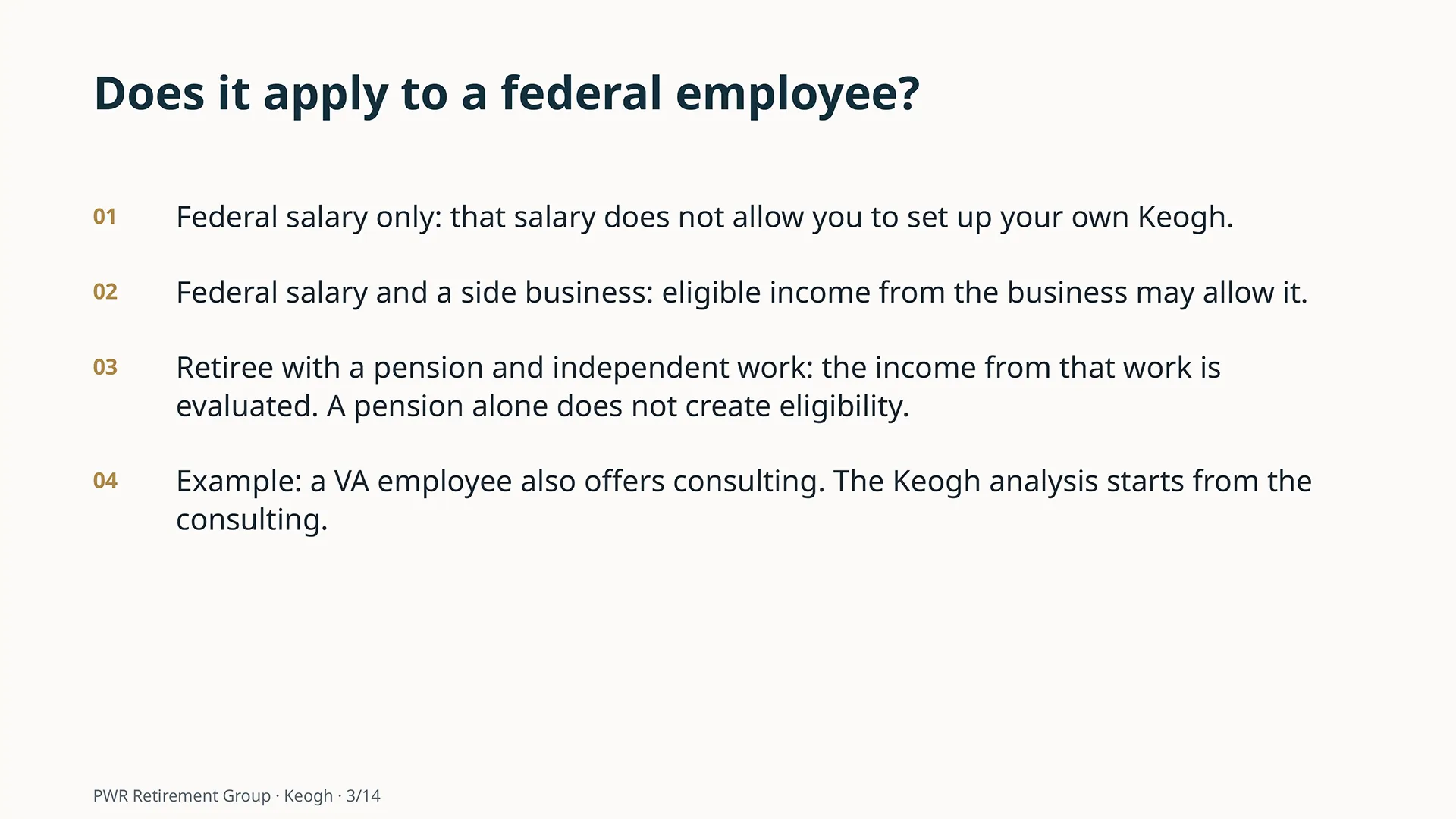
Eligibility comes from self-employment or business income, not from your federal job or pension.

NOT ON ITS OWN

Federal salary only

A federal salary alone does not allow you to set up your own Keogh.

MAY QUALIFY

Federal salary + side business

Eligible income from the business may allow it.

MAY QUALIFY

Retiree + independent work

Income from that work is evaluated. A pension alone does not create eligibility.

EXAMPLE

A VA employee who consults

She also offers consulting services. The Keogh analysis starts from her consulting income, not her VA salary.

Step by Step

How it works

01

Verify

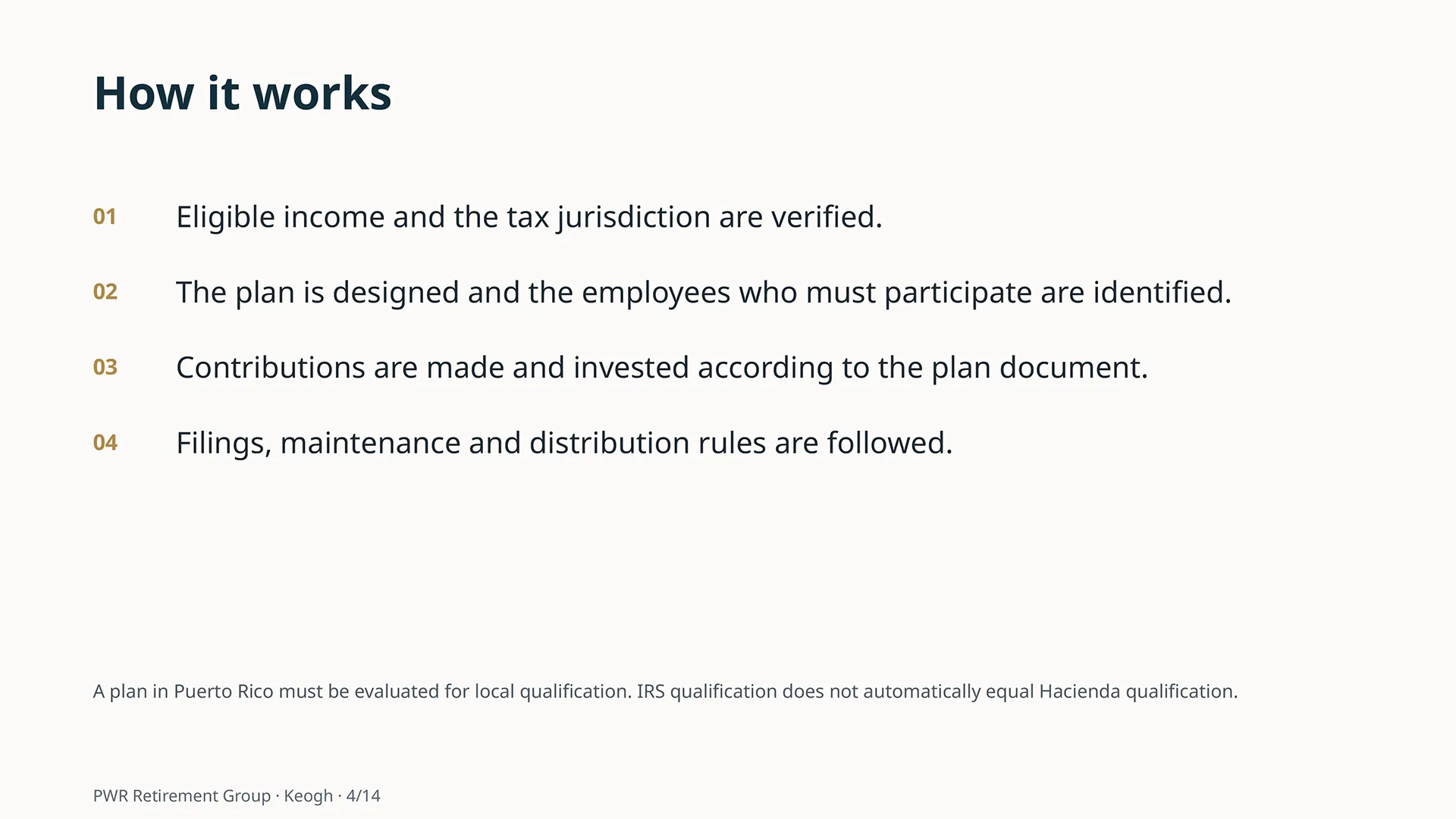
Eligible income and your tax jurisdiction are confirmed.

02

Design

The plan is designed and any employees who must participate are identified.

03

Contribute

Contributions are made and invested according to the plan document.

04

Maintain

Filings, plan maintenance and distribution rules are kept up to date.

  • A plan in Puerto Rico must be evaluated for local qualification. IRS qualification does not automatically mean qualification with Hacienda.

Illustrative Examples

What the numbers could look like
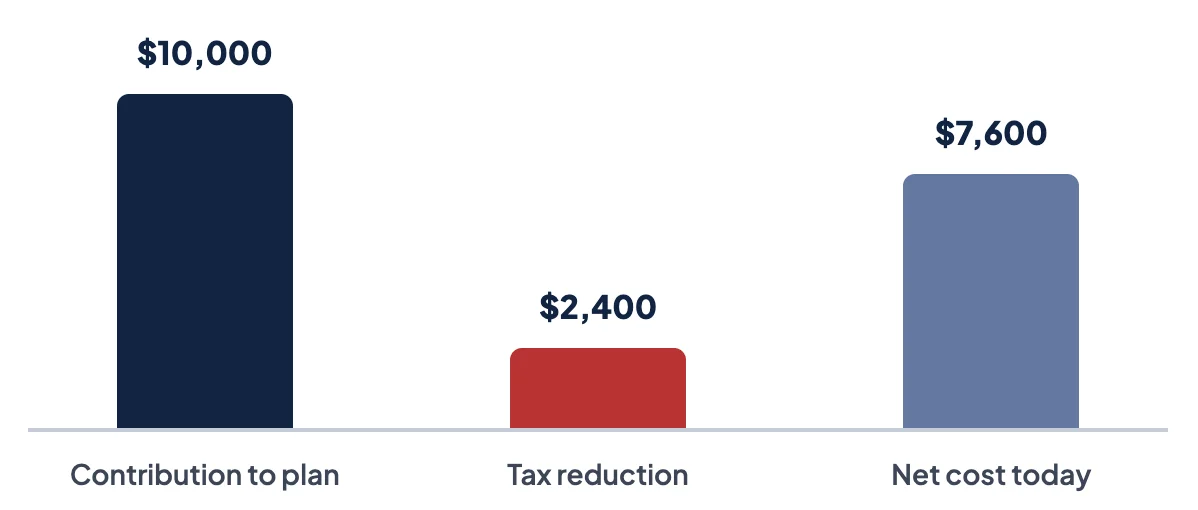
Example: a tax deduction today

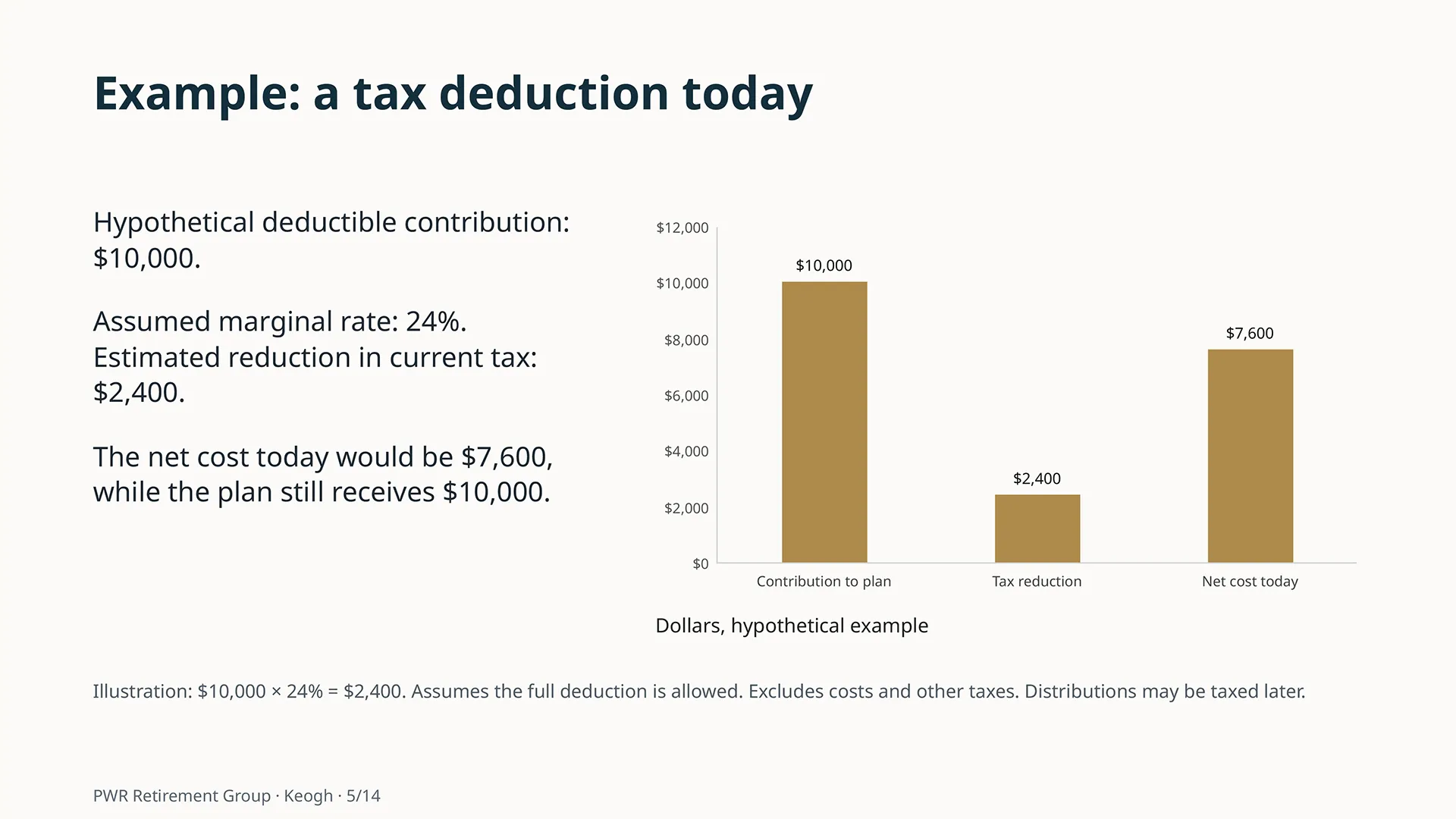
Hypothetical deductible contribution: $10,000.

Assumed marginal tax rate: 24%. Estimated reduction in current tax: $2,400.

The net cost today would be $7,600, while the plan still receives $10,000.

Illustration: $10,000 × 24% = $2,400. Assumes the full deduction is allowed. Excludes costs and other taxes. Distributions may be taxed later.

Example: added income in retirement

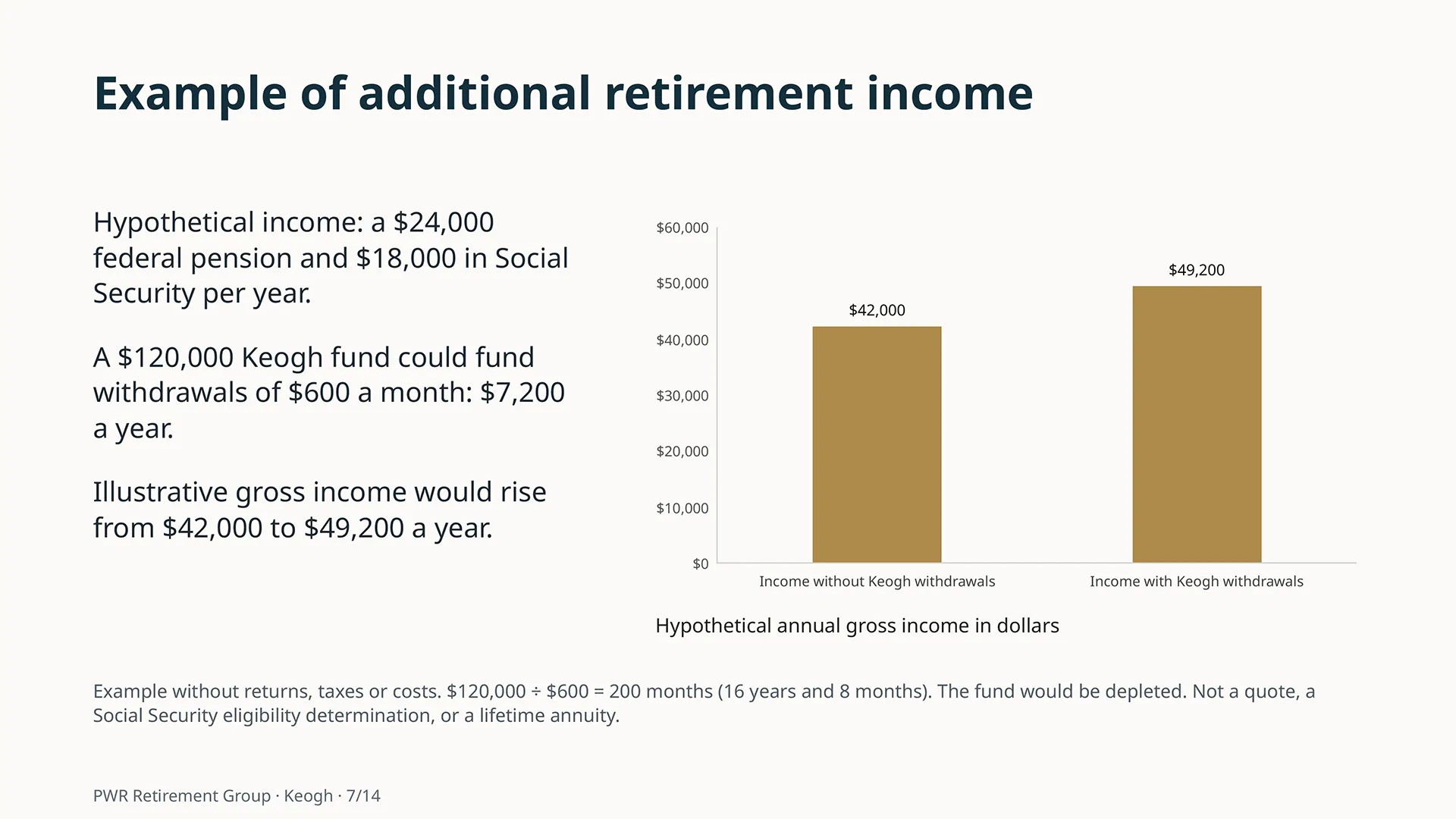
Hypothetical income: a $24,000 federal pension and $18,000 in Social Security per year.

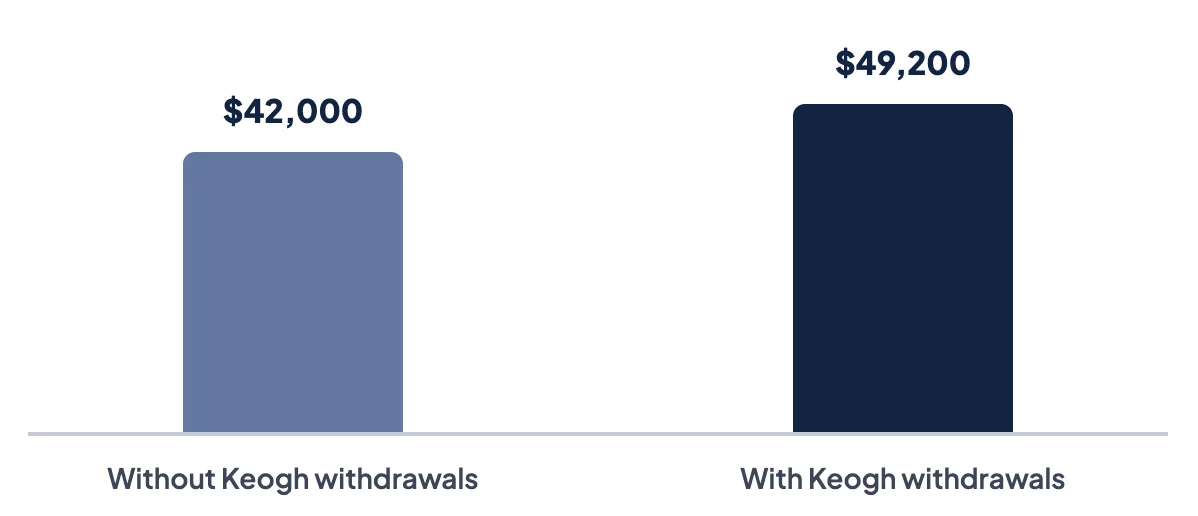
A $120,000 Keogh fund could support withdrawals of $600 a month, or $7,200 a year.

Illustrative gross income would rise from $42,000 to $49,200 a year.

Hypothetical annual gross income. No returns, taxes or costs. $120,000 ÷ $600 = 200 months (16 years, 8 months), after which the fund would be depleted. Not a quote, a Social Security eligibility determination, or a lifetime annuity.

In Retirement

Benefits when you retire

An additional fund

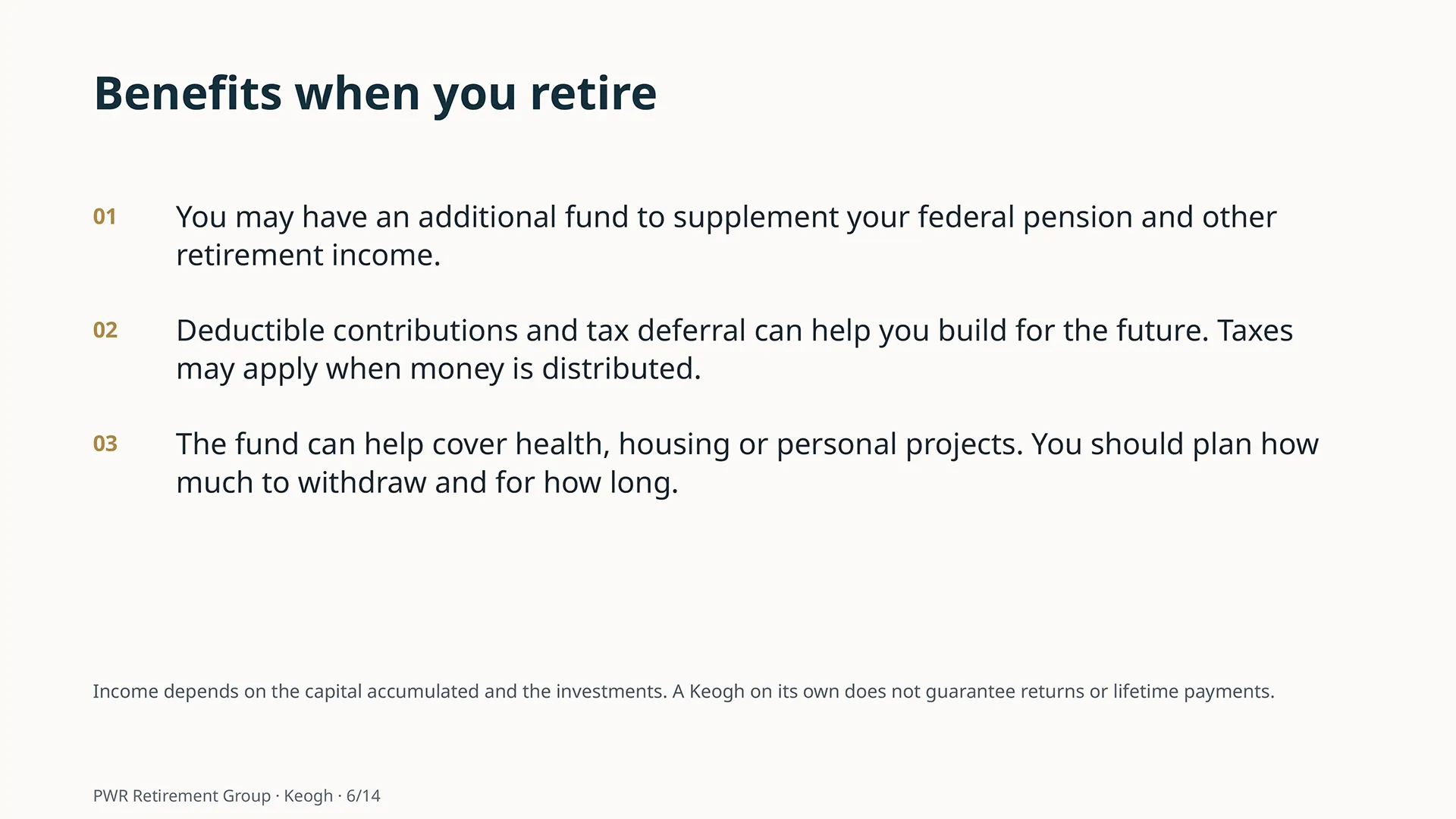
You may have an extra fund to supplement your federal pension and other retirement income.

Tax-deferred growth

Deductible contributions and tax deferral can help you build for the future. Taxes may apply when money is distributed.

Flexibility for real needs

The fund can help cover health, housing or personal projects. Plan how much to withdraw and for how long.

Income depends on the capital accumulated and the investments. A Keogh on its own does not guarantee returns or lifetime payments.

Common Scenarios

Lawsuits, divorce and inheritance

A Keogh can carry legal protections, but they depend on the plan’s structure and the
applicable law. These educational examples show where the limits are.

If you face a lawsuit

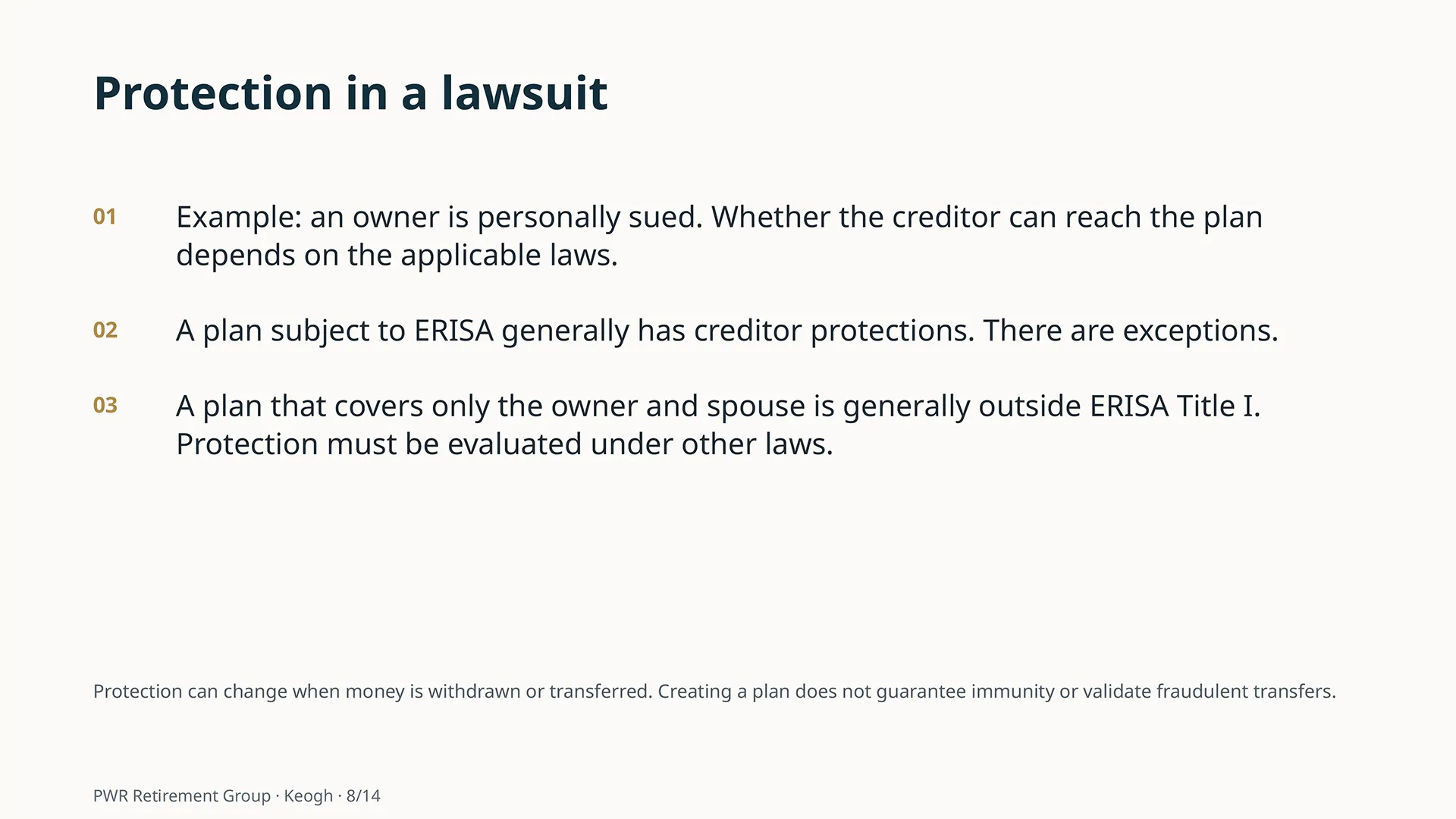
An owner is personally sued. Whether a creditor can reach the plan depends on the applicable laws.

A plan subject to ERISA generally has creditor protections, with exceptions. A plan that covers only the owner and spouse is generally outside ERISA Title I, so protection must be evaluated under other laws.

Protection can change once money is withdrawn or transferred. Creating a plan does not guarantee immunity or validate fraudulent transfers.

In a divorce

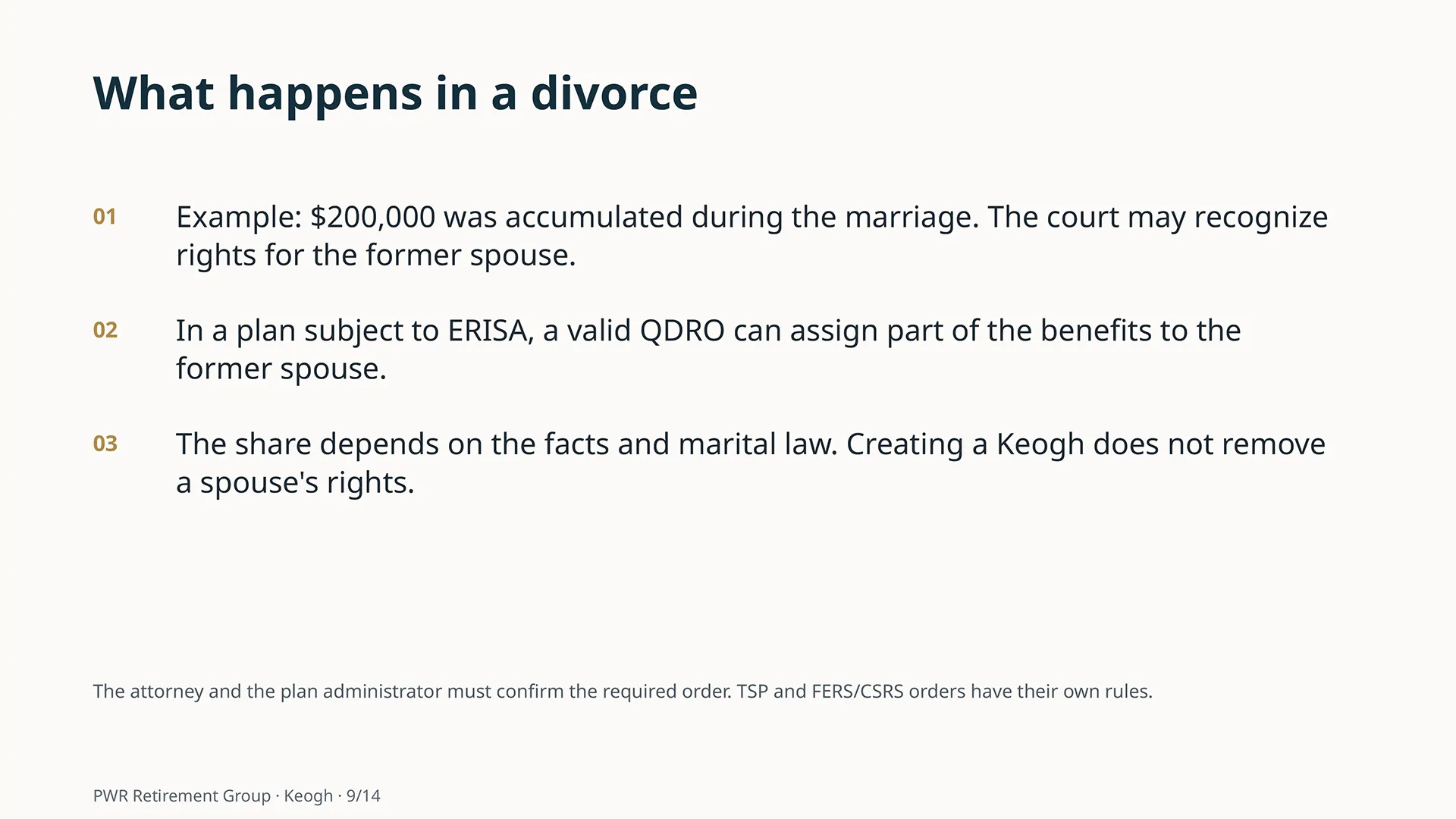
Example: $200,000 was accumulated during the marriage. A court may recognize rights for the former spouse.

In an ERISA plan, a valid QDRO can assign part of the benefits to the former spouse. The share depends on the facts and marital law. Creating a Keogh does not remove a spouse’s rights.

The attorney and plan administrator must confirm the required order. TSP and FERS/CSRS orders follow their own rules.

For your heirs

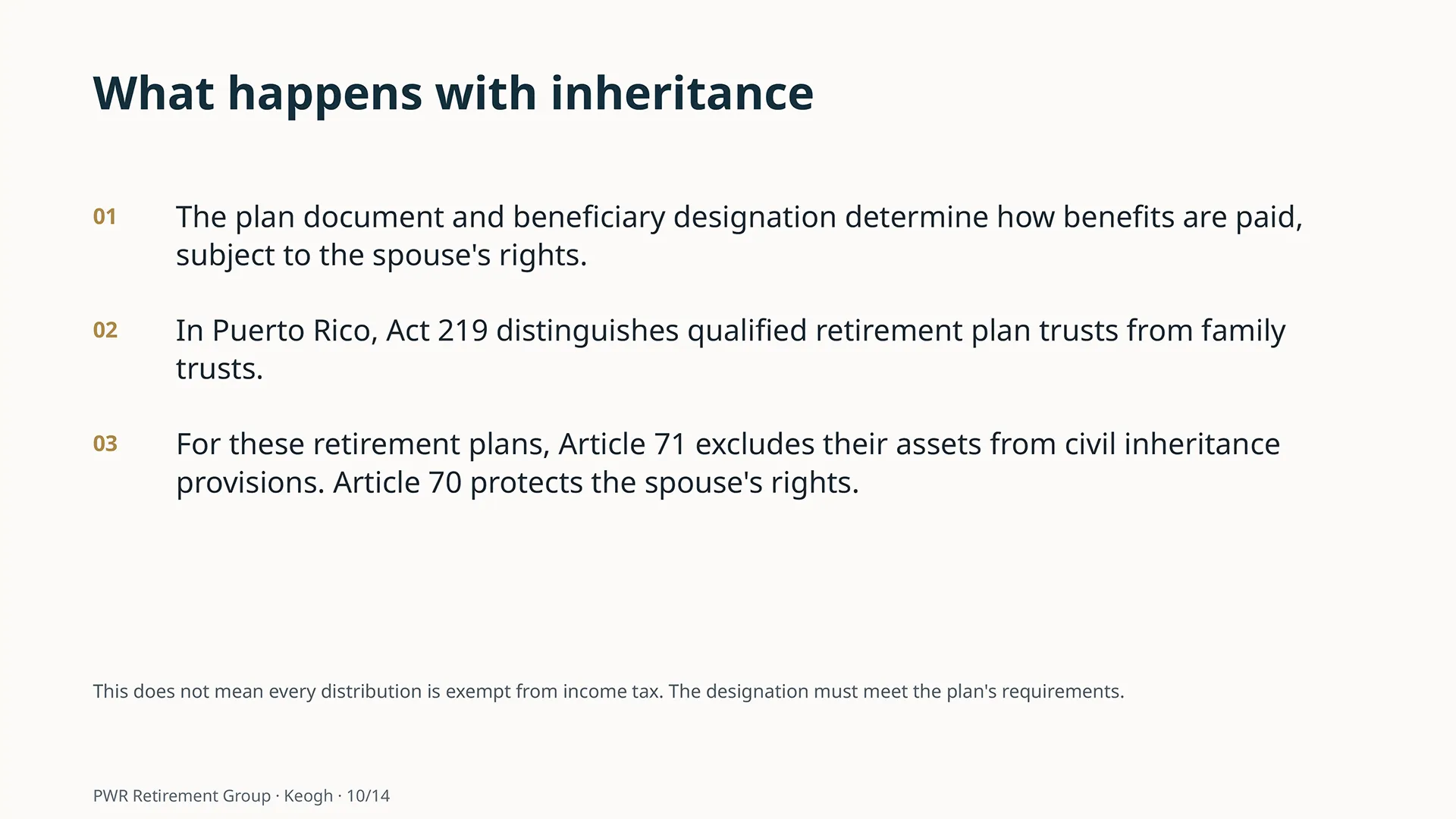
The plan document and beneficiary designation determine how benefits are paid, subject to the spouse’s rights.

In Puerto Rico, Act 219 separates qualified retirement plan trusts from family trusts. For these plans, Article 71 excludes their assets from civil inheritance provisions, and Article 70 protects the spouse’s rights.

This does not make every distribution exempt from income tax. Designations must meet the plan’s requirements.

Puerto Rico

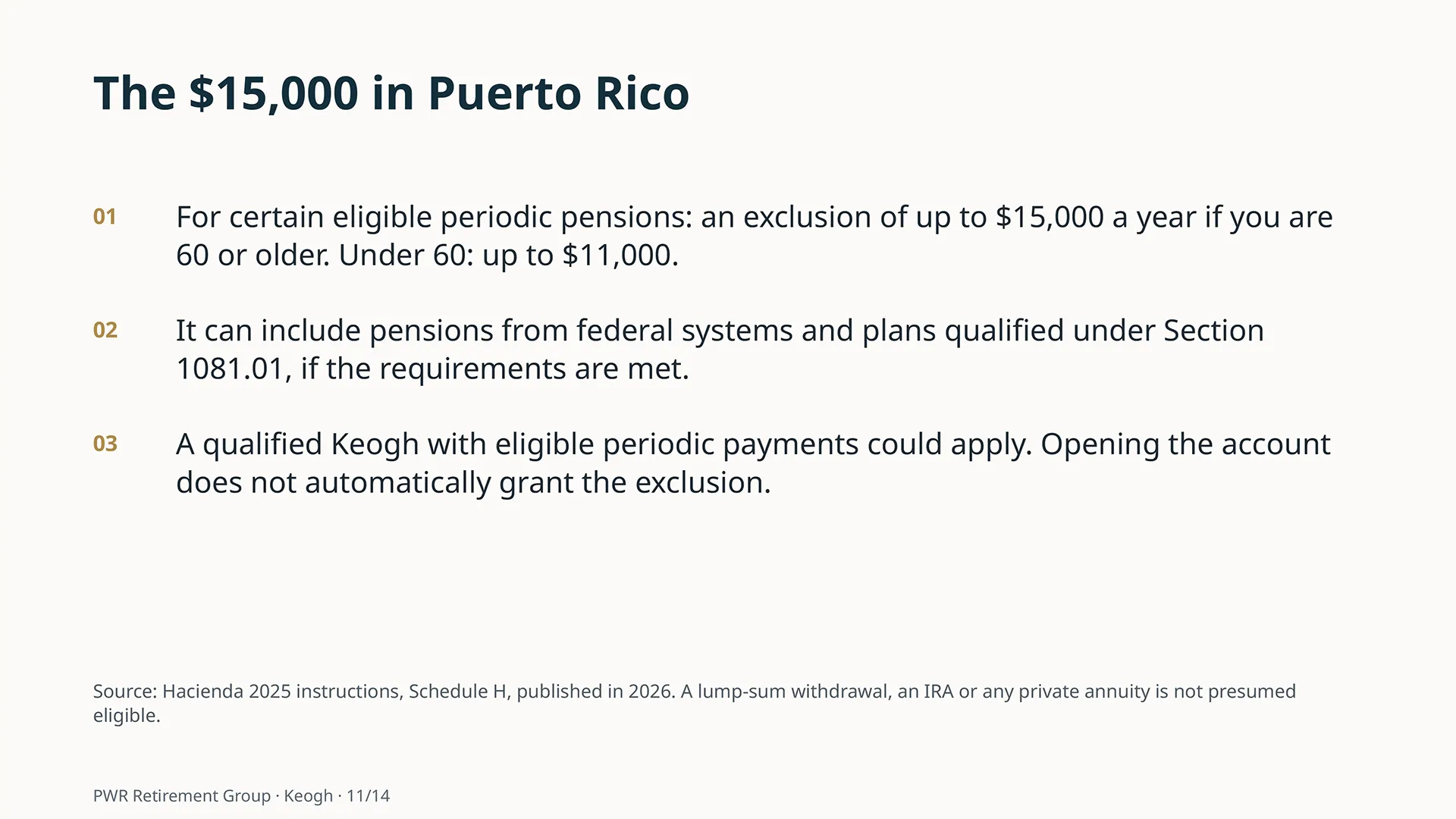
The $15,000 exclusion in Puerto Rico
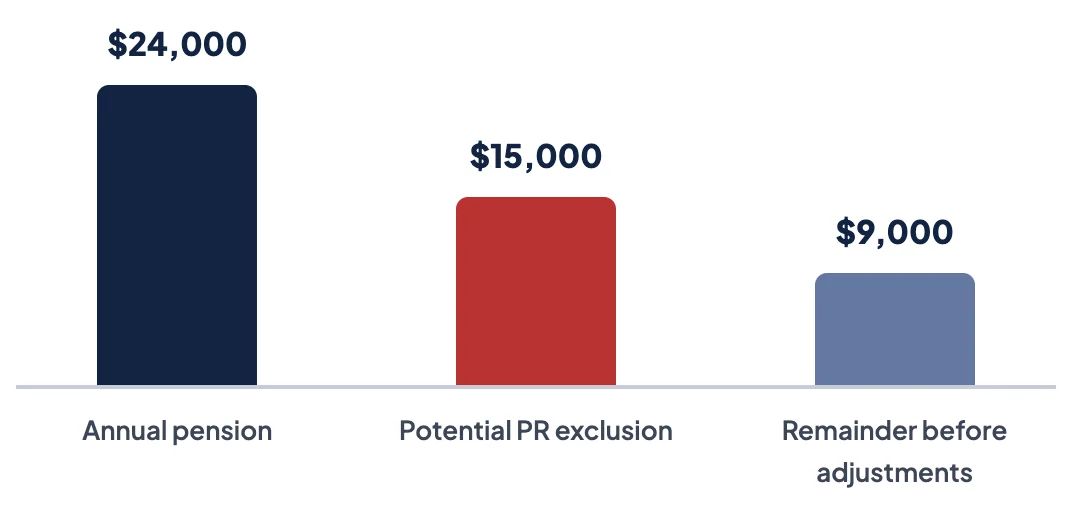
Source: Hacienda 2025 instructions, Schedule H, published in 2026. A lump-sum withdrawal, an IRA or any private annuity is not presumed eligible.

Example: eligible pension in PR

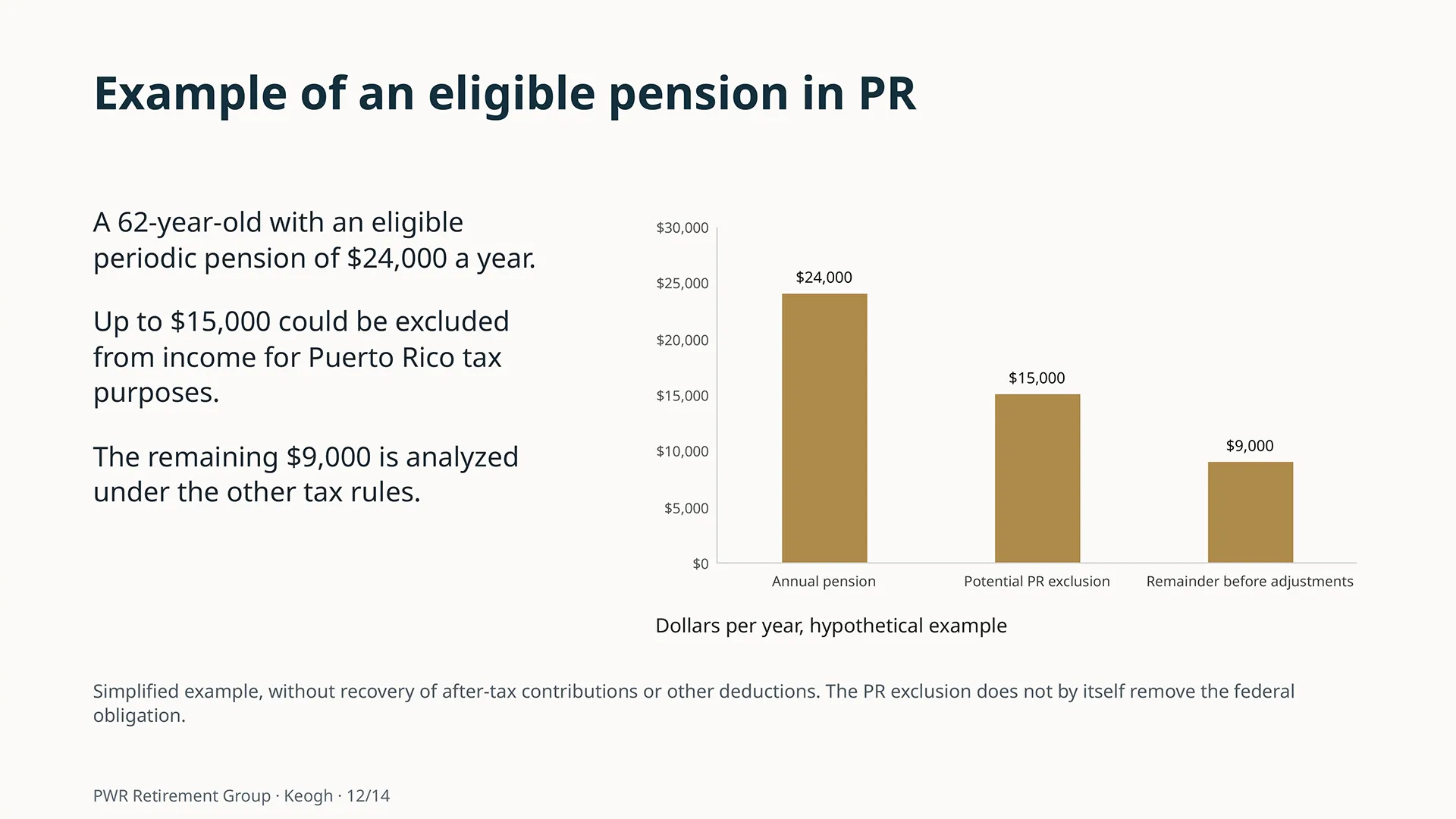
A 62-year-old with an eligible periodic pension of $24,000 a year. Up to $15,000 could be excluded from Puerto Rico taxable income; the remaining $9,000 is analyzed under the other tax rules.

Simplified, hypothetical example in dollars per year. Excludes recovery of after-tax contributions and other deductions. The PR exclusion does not by itself remove the federal obligation.

Where You Live Matters

Puerto Rico and the states

  • 1

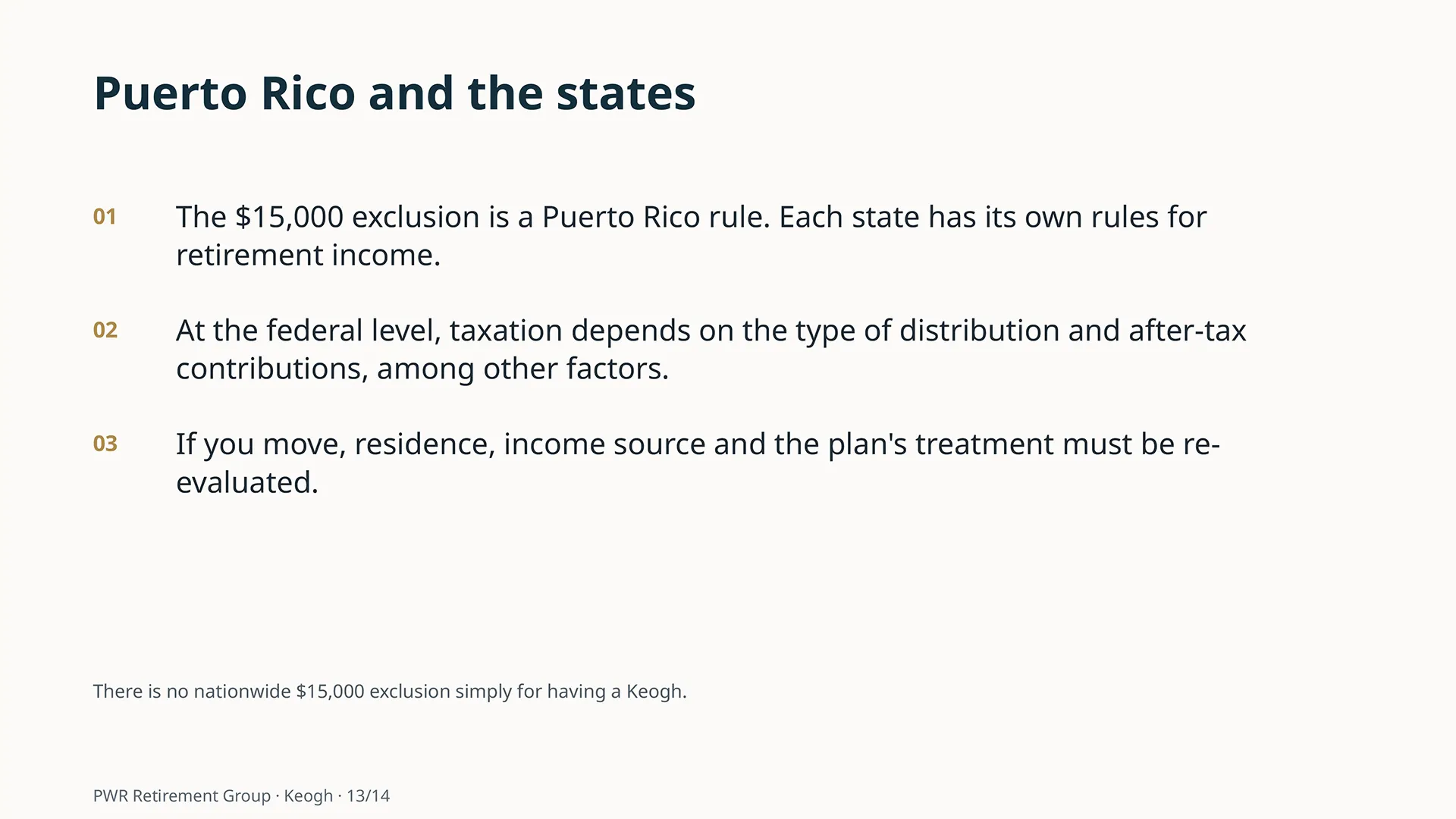
    The $15,000 exclusion is a Puerto Rico rule. Each state has its own rules for retirement income.

  • 2

    At the federal level, taxation depends on the type of distribution and any after-tax contributions, among other factors.

  • 3

    If you move, residence, income source and the plan’s treatment must be re-evaluated.

There is no nationwide $15,000 exclusion simply for having a Keogh.

For Federal Employees

How it fits with your federal retirement

  • 1

    A Keogh can add savings from an eligible business while you keep your TSP and FERS/CSRS planning in place.

  • 2

    Before contributing, review your income, plan costs, obligations to employees, and money set aside for emergencies.

  • 3

    PWR provides education. Plan design and legal and tax review belong to licensed professionals.

Frequently Asked Questions

What people ask us most

No. A Keogh is based on eligible self-employment or business income. A federal salary or pension alone does not create eligibility.

No. It can sit alongside your TSP and FERS/CSRS planning as an additional source of retirement savings from a business.

Not necessarily. Contributions may be deductible, but distributions may be taxed later depending on the type of distribution and where you live.

Not automatically. A qualified Keogh with eligible periodic payments could apply, depending on your age and the requirements.

It depends. ERISA plans generally have protections with exceptions, while owner-only plans must be evaluated under other laws.

Turn your side business into part of your retirement plan

Talk with a PWR educator about whether a Keogh fits your income, your
residence and your federal benefits.