





For many federal employees, retirement isn’t just another milestone—it’s the reward for decades of dedicated public service. Over the years, you’ve consistently contributed to your Thrift Savings Plan (TSP), earned valuable FERS benefits, and worked toward the financial security you’ve envisioned for yourself and your family. But as retirement draws closer, the focus begins to shift. It’s no longer just about growing your savings; it’s about protecting what you’ve built and making smart decisions that will support your income for years to come.
Surprisingly, some of the most expensive retirement mistakes don’t happen early in your career—they happen during the final five years before retirement. Decisions about taxes, withdrawals, investment allocations, and retirement income can have a lasting impact on how much of your hard-earned savings you actually keep.
This guide highlights the most common TSP mistakes federal employees make before retirement and explains how to avoid them. Whether you’re planning to retire in Georgia or anywhere else in the United States, these practical insights can help you enter retirement with greater confidence and a stronger financial strategy.
Why the Last Five Years Before Retirement Matter More Than the Previous Twenty
Throughout most of your career, your retirement strategy likely centered on one objective: accumulating as much as possible. You contributed regularly to your TSP, benefited from agency matching contributions, and watched your investments grow over time.
However, the last five years before retirement represent what financial professionals often call the “Retirement Red Zone.” During this period, your financial decisions become increasingly important because you have less time to recover from costly mistakes or unexpected market downturns.
Instead of asking, “How much can I save?”, the more important questions become:
- How will I generate retirement income?
- How can I reduce unnecessary taxes?
- Is my investment strategy still appropriate?
- Have I prepared for Required Minimum Distributions (RMDs)?
- Will my retirement income support my lifestyle?
These questions require a different mindset—one focused on preservation, tax efficiency, and long-term income planning.
According to the Federal Retirement Thrift Investment Board, the TSP manages more than $900 billion in retirement assets for millions of federal employees and members of the uniformed services, making it one of the largest defined contribution retirement plans in the world.
Understanding how to maximize those savings during the final years of your career can make a meaningful difference throughout retirement.
Mistake #1: Waiting Too Long to Create a TSP Withdrawal Strategy
Many federal employees spend decades learning how to contribute to the TSP but very little time understanding how they’ll eventually withdraw those funds.
That’s a problem.
A successful retirement isn’t determined solely by the size of your TSP account—it’s determined by how efficiently you use it.
Some retirees assume they’ll simply withdraw money whenever they need it. Others delay planning until after retirement, only to discover that poor withdrawal decisions can increase taxes, reduce investment growth, or create cash flow challenges.
Instead, begin developing a withdrawal strategy several years before your planned retirement date.
Consider questions such as:
- How much monthly income do you really need?
- Which accounts should you withdraw from first?
- How will TSP withdrawals affect your tax bracket?
- How will withdrawals coordinate with your FERS pension and Social Security benefits?
Planning these decisions in advance provides greater flexibility and may help reduce lifetime taxes.
If you’re interested in learning more about retirement income planning, exploring educational resources and Upcoming Events can provide valuable insights into how TSP withdrawals fit within your overall federal retirement strategy.
Mistake #2: Ignoring Taxes When Withdrawing from Your TSP
Many federal employees focus heavily on growing their TSP balance but spend very little time preparing for the taxes they’ll owe once retirement begins.
This oversight can significantly reduce retirement income.
Funds contributed to a Traditional TSP are generally tax-deferred, which means withdrawals during retirement are usually taxed as ordinary income.
Without proper planning, large withdrawals could:
Move you into a higher federal tax bracket
Increase the taxation of Social Security benefits
Affect Medicare premiums through Income-Related Monthly Adjustment Amounts (IRMAA)
Reduce the overall efficiency of your retirement income plan
For this reason, retirement tax planning deserves as much attention as investment performance.
The Internal Revenue Service explains that distributions from traditional retirement accounts are generally subject to federal income tax unless specific exceptions apply.
Rather than reacting to taxes after retirement, consider creating a proactive withdrawal strategy that coordinates your TSP with other retirement income sources.
Many employees approaching retirement also evaluate whether Roth conversion opportunities or phased withdrawals could improve their long-term tax situation.
Since every financial situation is unique, personalized financial planning for government employees can help identify tax-saving opportunities based on your retirement goals, expected income, and future spending needs.
Mistake #3: Holding on to Your Age-35 Investment Allocation
Your investment strategy should evolve as you move through different stages of your career.
The portfolio that helped maximize growth in your thirties may expose you to unnecessary risk when retirement is only a few years away.
Yet many federal employees never revisit their TSP allocation.
Some continue holding aggressive stock-heavy portfolios despite nearing retirement, while others move entirely into conservative investments too early and sacrifice years of potential growth.
The goal isn’t to eliminate investment risk altogether—it’s to manage it wisely.
Ask yourself:
- Does my current allocation reflect my retirement timeline?
- Am I prepared for market volatility just before retirement?
- Have I reviewed my Lifecycle Fund selection recently?
- How would a major market correction affect my retirement plans?
A balanced investment strategy should support both growth and stability.
Equally important is understanding the sequence of returns risk—the possibility that poor market performance during the first years of retirement can have a greater impact on long-term financial security than downturns experienced earlier in your career.
If you’re unsure whether your current allocation still aligns with your retirement objectives, speaking with a federal financial consultant in Georgia or another experienced federal retirement professional can help you evaluate your options based on your unique goals rather than emotion or market headlines.
Mistake #4: Forgetting to Update Your TSP Beneficiaries
After years of contributing to your TSP, it’s easy to assume your retirement savings will automatically go to the right people. Unfortunately, that’s not always the case.
One of the most overlooked retirement planning tasks is keeping your beneficiary designations up to date.
Life changes quickly. You may have:
- Gotten married or divorced
- Had children or grandchildren
- Lost a spouse
- Changed your estate planning goals
If your beneficiary form hasn’t been updated, your retirement savings could be distributed differently than you intended.
Many federal employees are surprised to learn that beneficiary designation forms generally take precedence over instructions in a will. That means an outdated beneficiary could inherit your TSP account, even if your estate documents say otherwise.
As you approach retirement, review every beneficiary associated with your:
- Thrift Savings Plan (TSP)
- FEGLI Life Insurance
- Retirement accounts
- Bank and investment accounts
A simple review today could save your family significant legal and financial complications in the future.
Read More : How FMLA Leave Affects Your TSP, FERS Pension, and Retirement Timeline
Mistake #5: Missing Opportunities for Roth TSP Conversions
The introduction of in-plan Roth conversions has given federal employees another valuable retirement planning tool—but many still don’t understand when it makes sense.
A Roth conversion allows you to move money from your Traditional TSP into a Roth TSP. You’ll pay income tax on the converted amount today, but qualified withdrawals later can generally be tax-free.
Does that mean everyone should convert?
Not necessarily.
A Roth conversion could be a smart choice if you:
- Expect your retirement income to place you in a higher tax bracket
- Have several years before needing withdrawals
- Want more tax diversification
- Hope to reduce future Required Minimum Distributions (RMDs)
However, converting a large amount in one year could increase your taxable income and potentially affect Medicare premiums or other tax-related thresholds.
Rather than asking, “Should I convert?”, a better question is:
“How much should I convert, and when?”
The answer depends on your retirement timeline, projected income, and overall financial picture.
Mistake #6: Assuming Your TSP Alone Will Cover Retirement
A healthy TSP balance is an excellent foundation—but retirement income should never rely on a single source.
Federal retirees often have access to multiple income streams, including:
- FERS Pension
- Social Security
- Thrift Savings Plan
- Personal savings and investments
- Individual Retirement Accounts (IRAs)
The most successful retirement plans coordinate these income sources rather than depending heavily on one.
Healthcare costs, inflation, unexpected emergencies, and longer life expectancy can all affect how long your savings last.
Think of your retirement income like a table.
A table supported by one leg is unstable.
A table supported by four strong legs is much more resilient.
The same principle applies to retirement planning.
If your entire strategy depends on one account, you’re more vulnerable to taxes, market volatility, and unexpected expenses.
Creating a diversified retirement income strategy can help provide greater financial confidence throughout retirement.
Mistake #7: Waiting Until Retirement to Seek Professional Guidance
Many federal employees wait until they’re only weeks away from retirement before asking questions about their benefits.
By then, some planning opportunities may already have passed.
The years leading up to retirement are often the best time to review:
- TSP withdrawal strategies
- Pension estimates
- FEHB continuation
- FEGLI options
- Survivor benefits
- Medicare enrollment
- Social Security timing
- Tax planning
Making adjustments while you’re still working often provides more flexibility than making changes after retirement begins.
Whether you’re planning to retire in Atlanta, Savannah, Augusta, Columbus, or elsewhere, working with a federal financial consultant in Georgia who understands the unique rules governing federal retirement benefits can help you make more informed decisions.
Professional guidance isn’t about predicting the future—it’s about reducing uncertainty and avoiding costly mistakes.
Read More : Secure Your Florida Federal Retirement for a Stronger Future
Frequently Asked Questions About TSP Before Retirement
How much should I have in my TSP five years before retirement?
There’s no universal number. The right balance depends on your expected retirement expenses, pension income, Social Security benefits, lifestyle goals, and other savings. Instead of comparing your balance to others, focus on whether your projected income will meet your retirement needs.
Should I move all my money into the G Fund before retiring?
Not necessarily.
While the G Fund offers stability, moving your entire portfolio into one fund could reduce long-term growth potential. Many retirees benefit from maintaining a diversified investment allocation that balances growth with risk management.
Can my retirement savings remain in the TSP after I retire?
Yes.
Many federal retirees choose to leave some or all of their money in the TSP because of its low administrative costs and flexible withdrawal options.
What is the safest TSP withdrawal strategy?
The safest strategy depends on your retirement income needs, tax situation, and other financial resources.
A thoughtful withdrawal plan should coordinate TSP distributions with your FERS pension and Social Security benefits while considering future tax obligations.
Is it too late to improve my retirement plan if I’m only a few years away?
Absolutely not.
The final five years before retirement often present some of the most valuable planning opportunities. Reviewing your investments, taxes, and withdrawal strategy now can have a meaningful impact on your retirement income later.
Your Five-Year TSP Retirement Checklist
Before you submit your retirement paperwork, make sure you’ve completed these important steps:
✔ Review your current TSP investment allocation.
✔ Update all beneficiary designations.
✔ Estimate your retirement income from all sources.
✔ Understand your TSP withdrawal options.
✔ Review FEHB and FEGLI coverage.
✔ Estimate future healthcare expenses.
✔ Understand Required Minimum Distribution (RMD) rules.
✔ Create a written retirement income strategy.
Completing this checklist can help you avoid many of the common mistakes discussed throughout this article.
Conclusion
The years leading up to retirement can be just as important as the decades spent building your TSP. While market performance plays a role, the decisions you make about withdrawals, taxes, investments, and beneficiary planning often have a greater impact on your long-term financial security. Taking the time to review your retirement strategy now can help you avoid costly mistakes and make the transition from federal service to retirement much smoother. If you enjoy practical insights like these, Subscribe Now to receive timely updates, retirement planning tips, and educational content created specifically for federal employees.
Every retirement journey is unique, and there is no one-size-fits-all strategy. Whether you’re planning to retire in Georgia or elsewhere in the United States, staying informed allows you to make confident decisions based on your goals, timeline, and financial needs. Continue exploring trusted resources, retirement guides, and educational articles to build a stronger foundation for the years ahead.
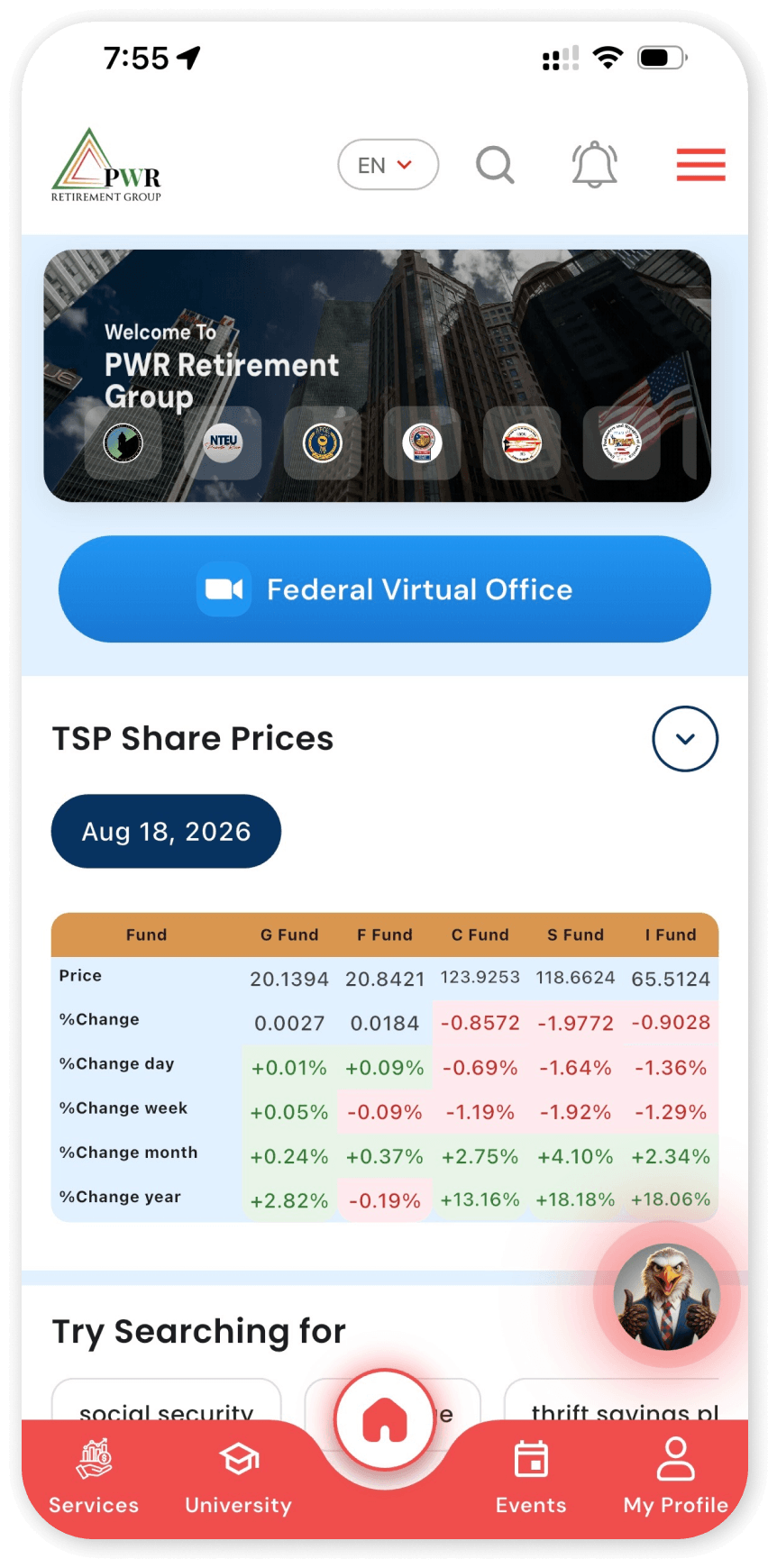
When you’re ready to take the next step, Download the PWR App Now to access helpful retirement planning tools, educational resources, and details about Upcoming Events designed for federal employees. Learning continuously and planning proactively today can help you enjoy greater confidence and financial independence throughout retirement.
Disclaimer: PWR Retirement is an independent private company and is not affiliated with, endorsed by, or acting on behalf of the United States Government, any federal agency, or any labor union. All information provided is for educational purposes only and should not be considered official government guidance, legal, tax, or financial advice. Eligibility determinations, benefit calculations, and claim approvals are made solely by the appropriate government agency.
Disclaimer: The information provided on this website and mobile application is for general educational and informational purposes only and does not constitute financial, investment, tax, legal, or retirement advice. PWR Retirement Group is an independent organization and is not affiliated with, endorsed by, or acting on behalf of any labor union, government agency, or employer. Users should consult an appropriately licensed financial professional, tax professional, or attorney regarding their individual circumstances before making financial, tax, legal, or retirement-related decisions.
PWR Retirement Group is an independent financial education firm and is not affiliated with, endorsed by, or sponsored by any federal agency, federal organization, government entity, or union.