



A way to organize your assets and shape how they reach your family.

An educational guide for federal employees and retirees in Puerto Rico and across the U.S.: what a trust is, how it works, and what it can, and cannot, do for your family.

Get your educational session

No cost. A PWR educator will reach out to talk through your situation.

"*" indicates required fields

Veteran*

Educational information only. Not legal or tax advice.

Get your educational session

No cost. A PWR educator will reach out to talk through your situation.

"*" indicates required fields

Veteran*

Educational information only. Not legal or tax advice.

The Presentation

Walk through the full Trusts presentation

Browse PWR’s educational presentation slide by slide, or download it to review later.

The Basics

What is a trust?

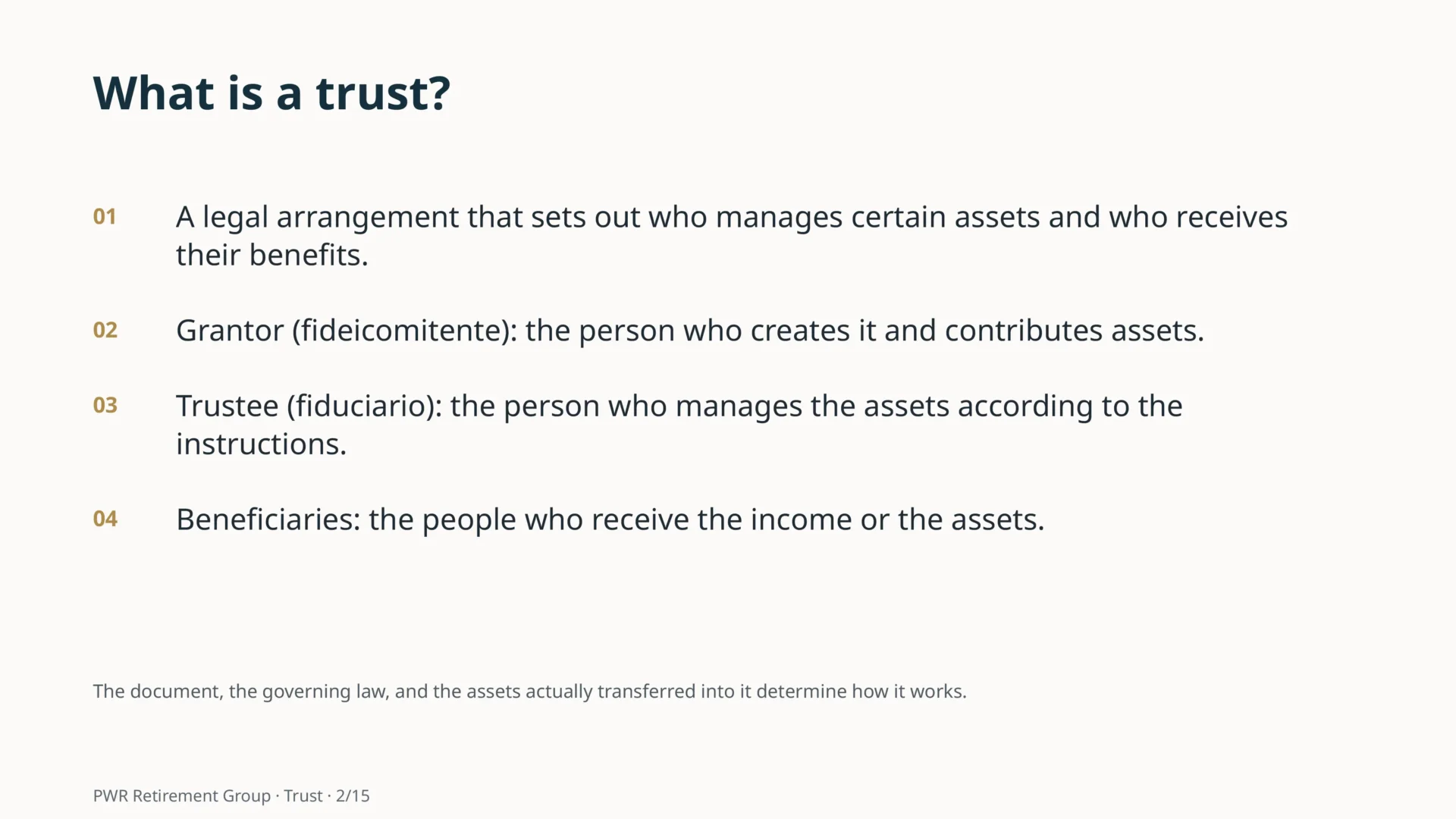
A trust is a legal arrangement that sets out who manages certain assets and who receives their benefits. Three roles are involved.

01

Grantor

The person who creates the trust and contributes the assets. Also called the settlor (fideicomitente).

02

Trustee

The person or institution that manages the assets according to the trust’s instructions (fiduciario).

03

Beneficiaries

The people who receive income or assets from the trust.

A trust is a legal arrangement that sets out who manages certain assets and who receives their benefits. Three roles are involved.

Step by Step

How it works in real life

01

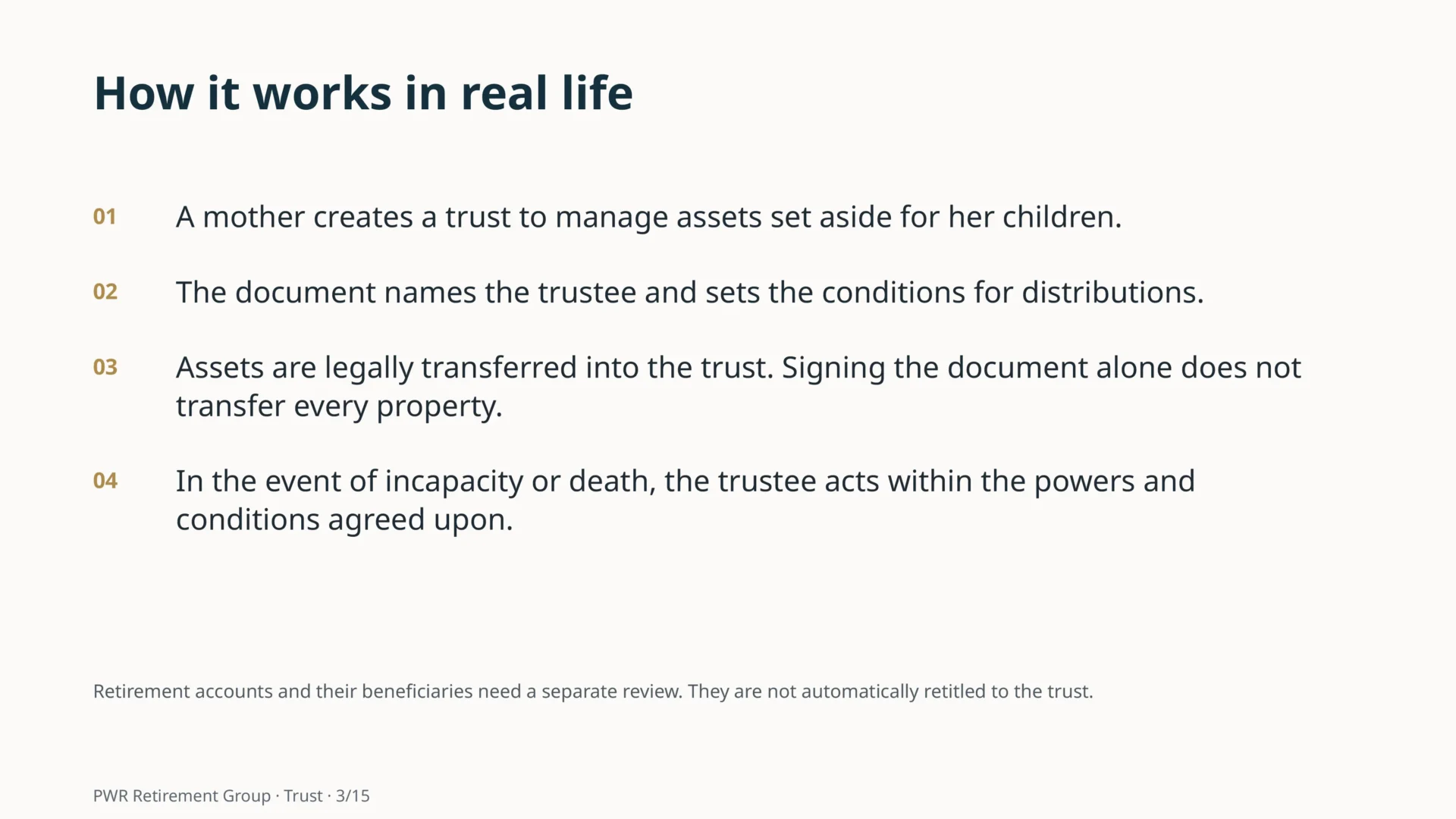
A mother creates a trust to manage assets set aside for her children.

02

The document names the trustee and sets the conditions for distributions.

03

Assets are legally transferred into the trust. Signing the document alone does not move every property.

04

In the event of incapacity or death, the trustee acts within the powers and conditions agreed upon.

Retirement accounts and their beneficiary designations need a separate review. They do not automatically become owned by the trust.

Types of Trusts

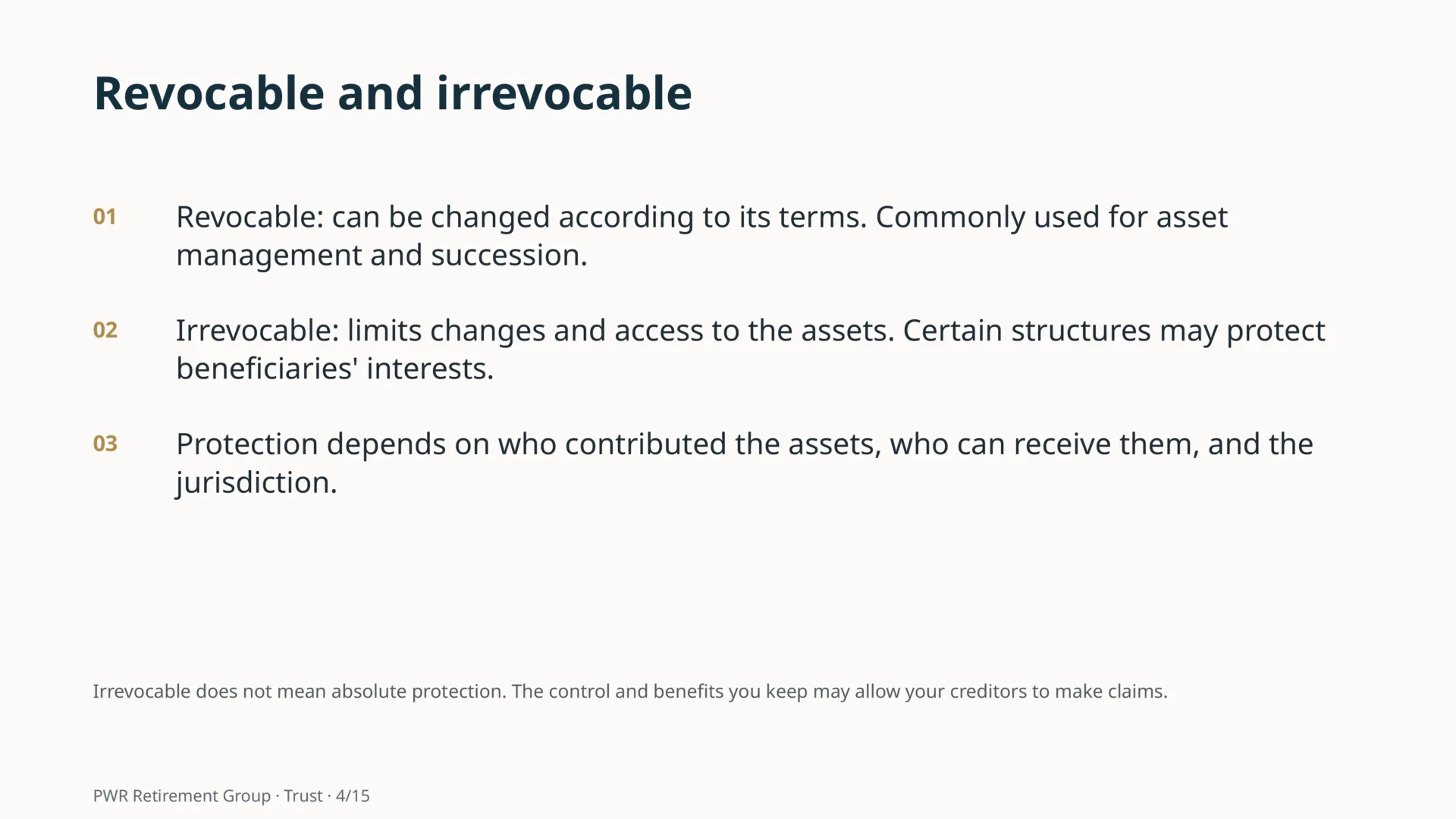
Revocable and irrevocable

FLEXIBLE
Revocable

Can be changed according to its terms.

  • Commonly used for asset management and succession.

WITH LIMITS
Irrevocable

Limits changes and access to the assets.

  • Certain structures may help protect beneficiaries’ interests.

  • Protection depends on who contributed the assets, who can receive them, and the jurisdiction.

Important: irrevocable does not mean absolute protection. The control and benefits you keep may allow your creditors to make claims.

What It Can Do

Benefits for federal families and in retirement

For your family
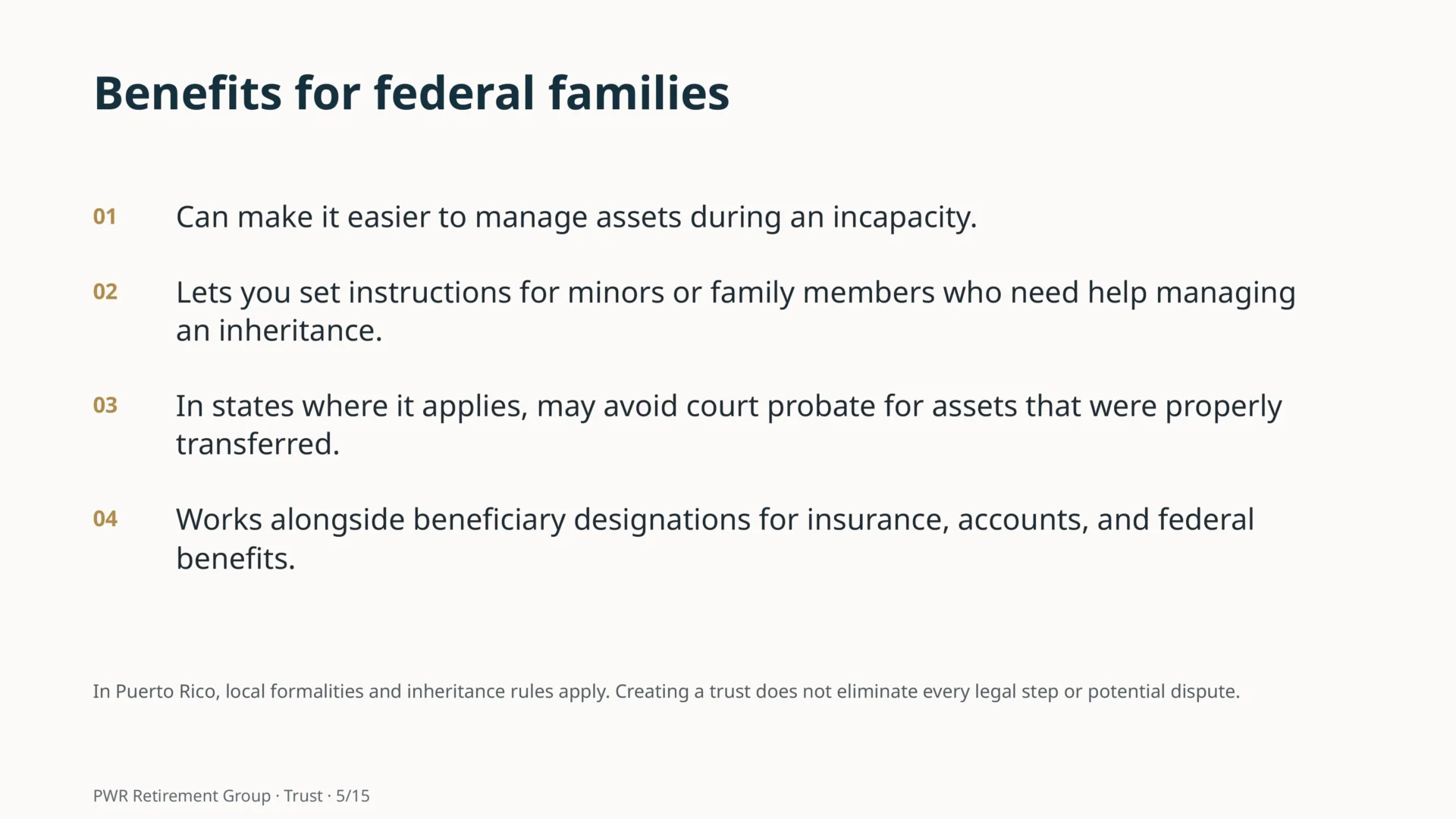
  • Can make it easier to manage assets during an incapacity.

  • Lets you set instructions for minors or family members who need help managing an inheritance.

  • In states where it applies, may avoid court probate for assets that were properly transferred.

  • Works alongside beneficiary designations for insurance, accounts, and federal benefits.

In Puerto Rico, local formalities and inheritance rules apply. Creating a trust does not eliminate every legal step or potential dispute.

During your retirement
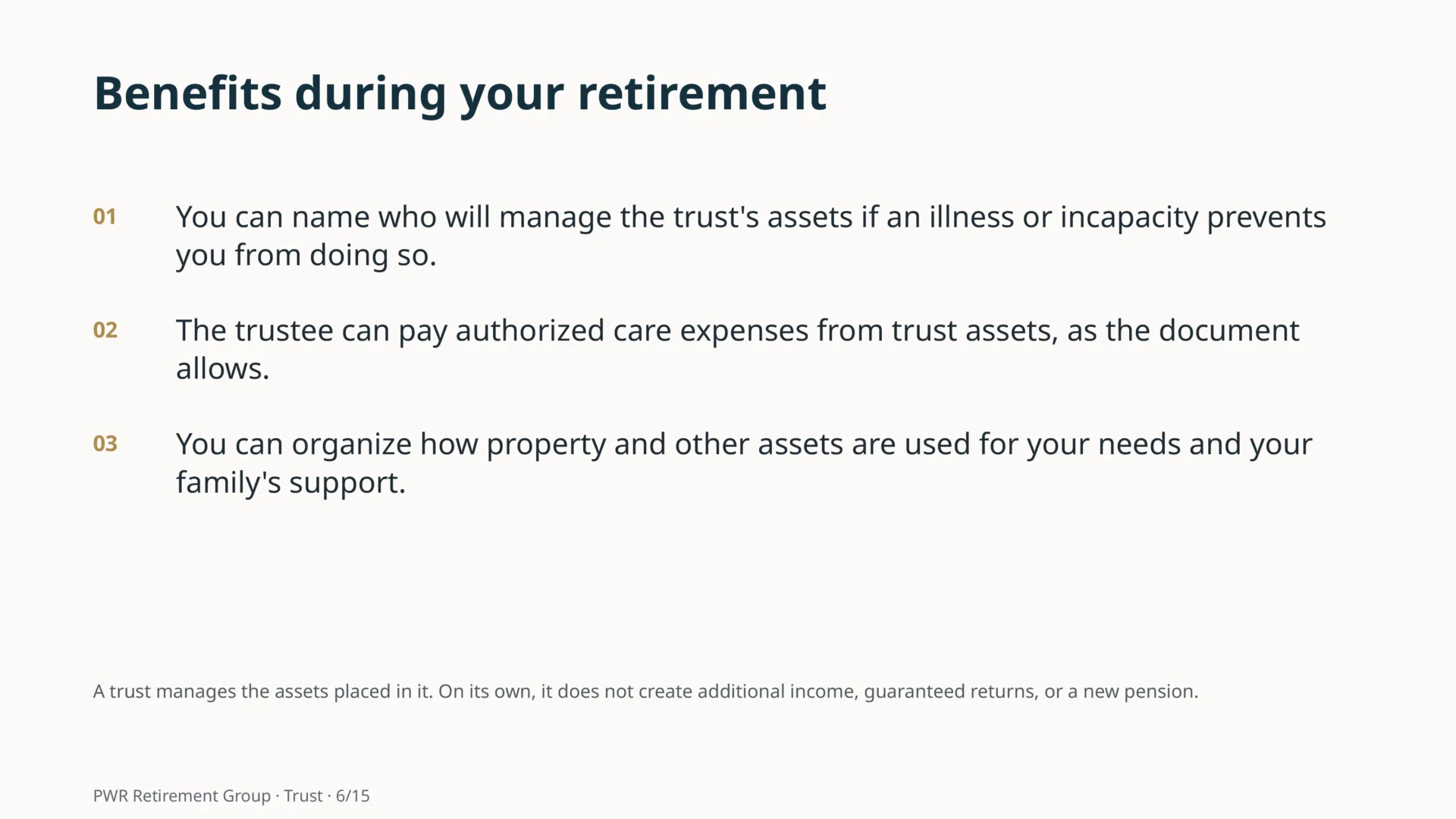
  • You can name who will manage the trust’s assets if an illness or incapacity prevents you from doing so.

  • The trustee can pay authorized care expenses from trust assets, as the document allows.

  • You can organize how property and other assets are used for your needs and your family’s support.

A trust manages the assets placed in it. On its own, it does not create additional income, guaranteed returns, or a new pension.

Educational Example

Continuity in retirement

TODAY

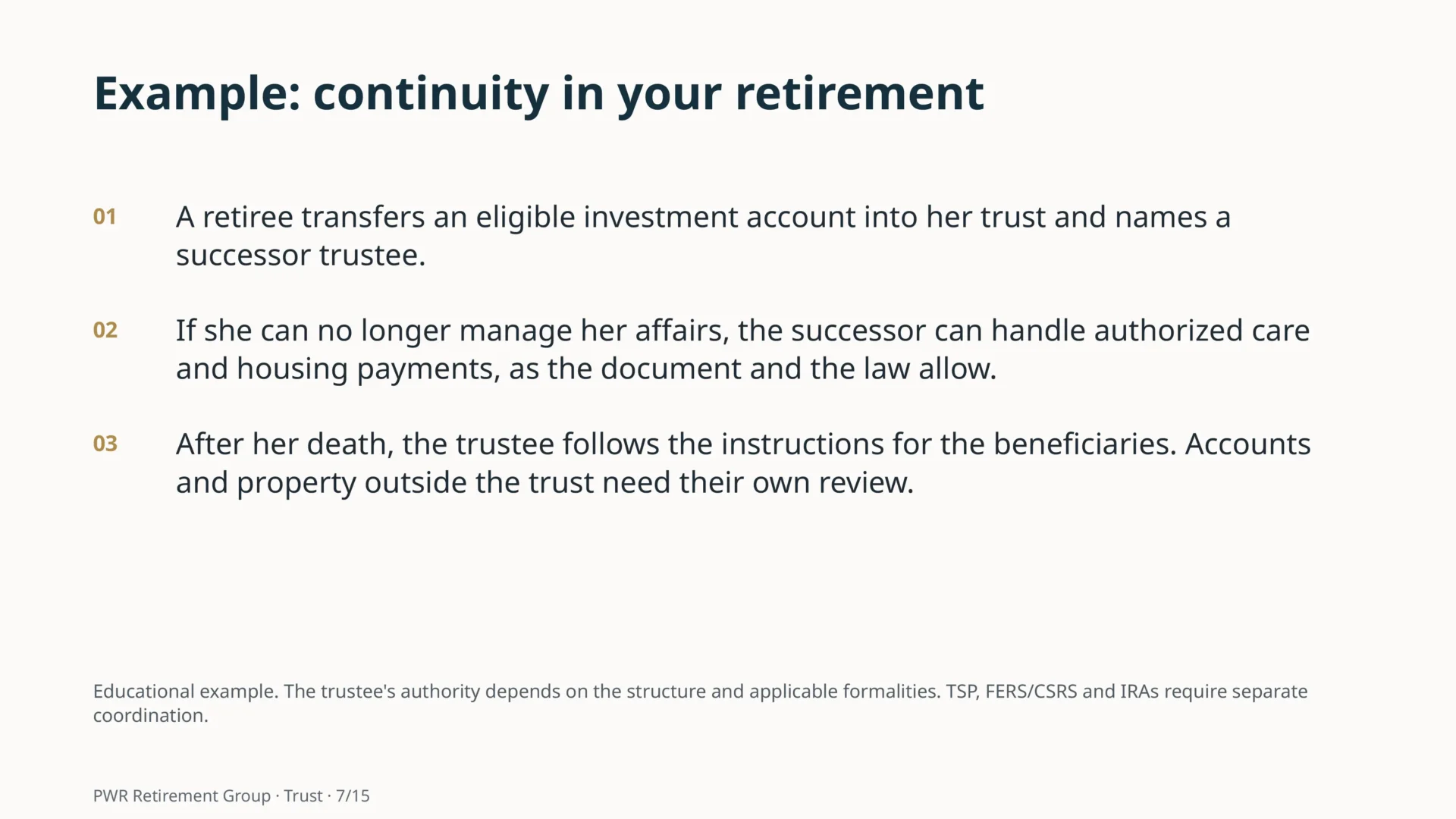
A retiree transfers an eligible investment account into her trust and names a successor trustee.

INCAPACITY

If she can no longer manage her affairs, the successor can handle authorized care and housing payments, as the document and the law allow.

AFTER DEATH

The trustee follows the instructions for the beneficiaries. Accounts and property outside the trust need their own review.

Educational example. The trustee’s authority depends on the structure and the applicable formalities. TSP, FERS/CSRS and IRAs require separate coordination.

Common Scenarios

Lawsuits, inheritances and divorce

A trust can help in certain situations, but it does not provide immunity. These educational
examples show why design and jurisdiction matter.

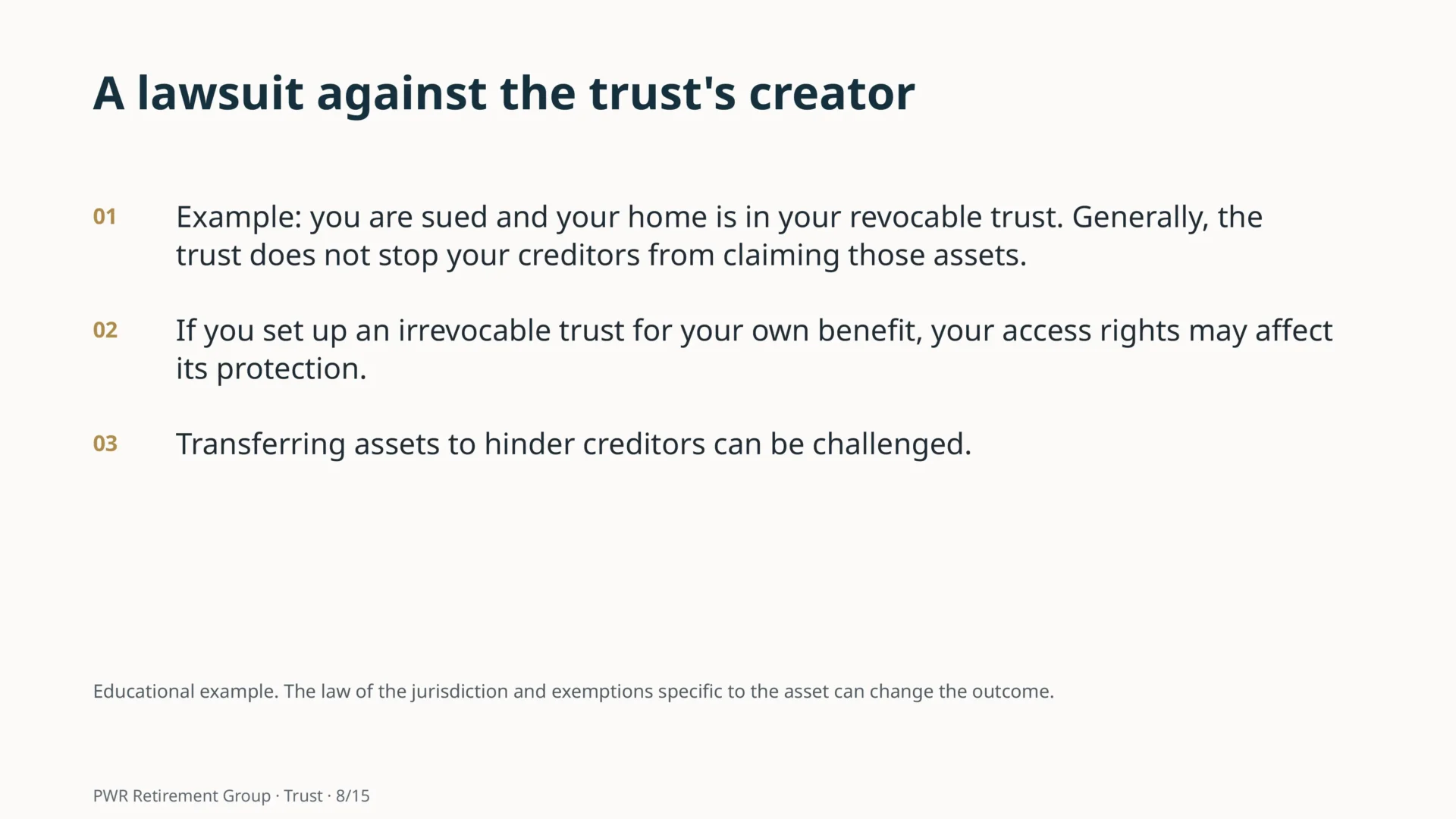
A lawsuit against the trust’s creator

If you are sued and your home is in your revocable trust, the trust generally does not stop your creditors from reaching it.

If you set up an irrevocable trust for your own benefit, your access rights may weaken its protection. Transfers made to hinder creditors can be challenged.

The law of the jurisdiction and exemptions specific to the asset can change the outcome.

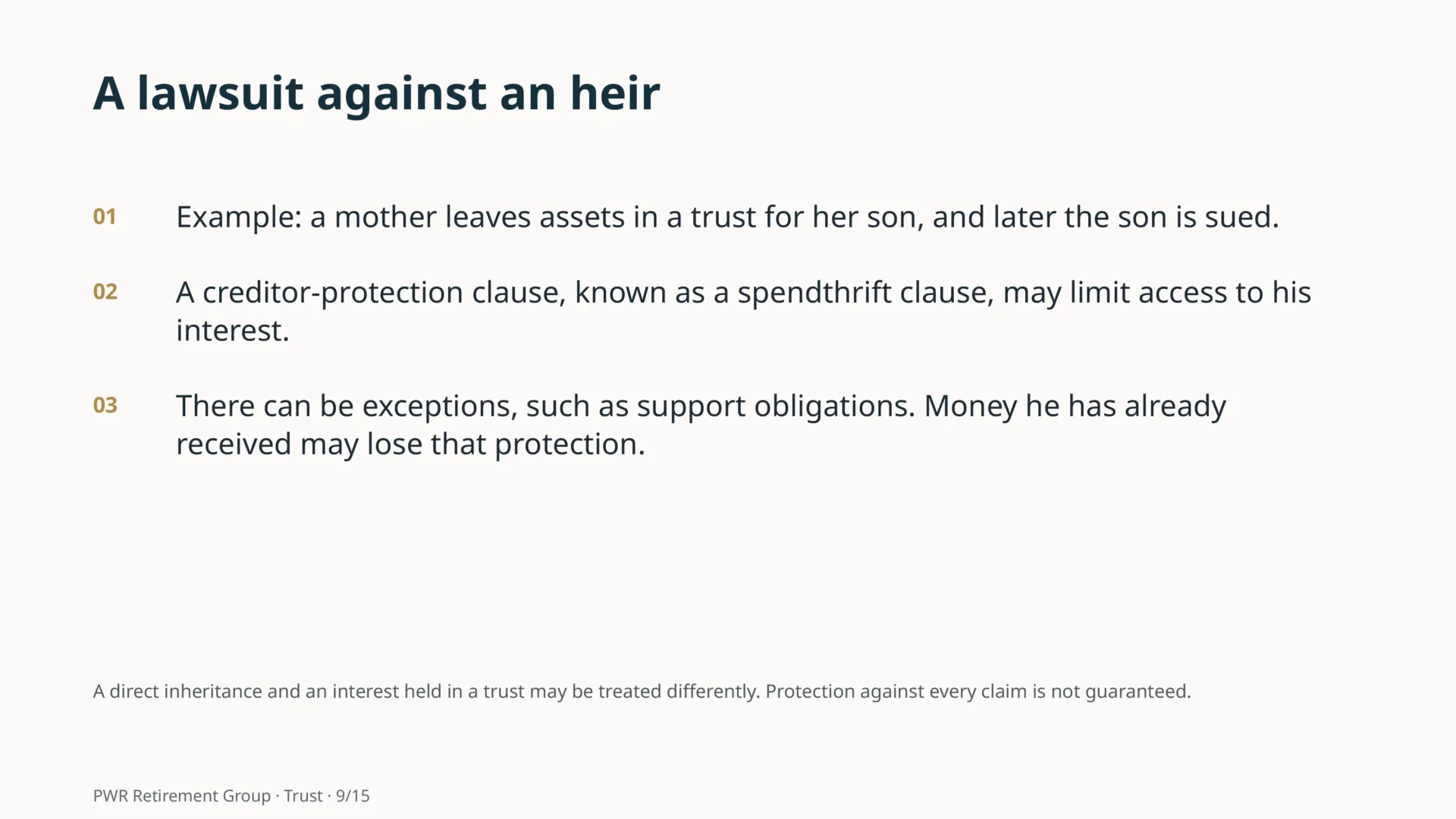
A lawsuit against an heir

A mother leaves assets in trust for her son, and later he is sued. A creditor-protection clause, known as a spendthrift clause, may limit access to his interest.

There can be exceptions, such as support obligations. Money he has already received may lose that protection.

A direct inheritance and an interest held in a trust may be treated differently.

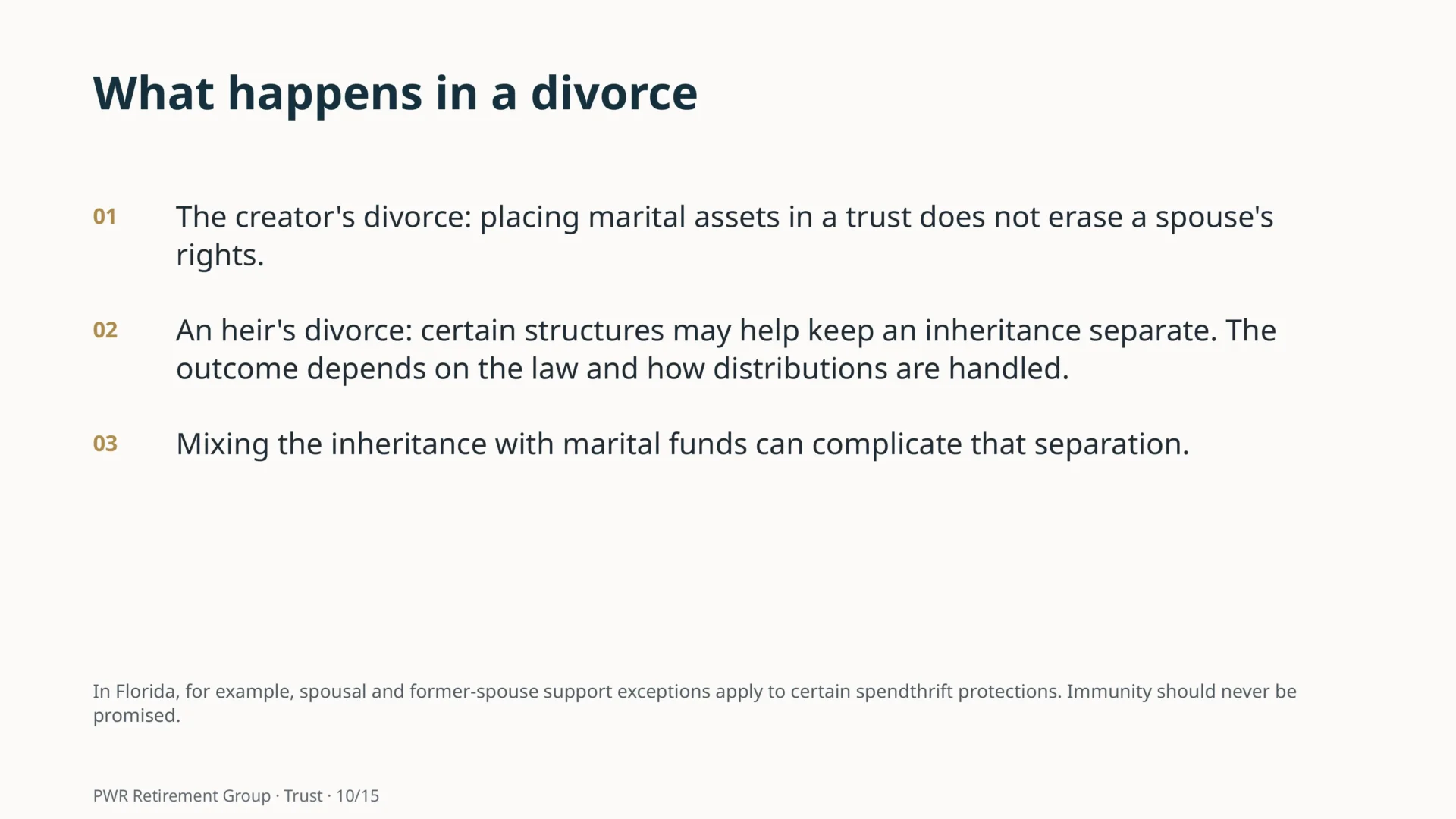
What happens in a divorce

The creator’s divorce: placing marital assets in a trust does not erase a spouse’s rights.

An heir’s divorce: certain structures may help keep an inheritance separate. Mixing it with marital funds can make that separation harder.

In Florida, for example, spousal and former-spouse support exceptions apply to certain spendthrift protections.

Illustration

Example of a staged inheritance

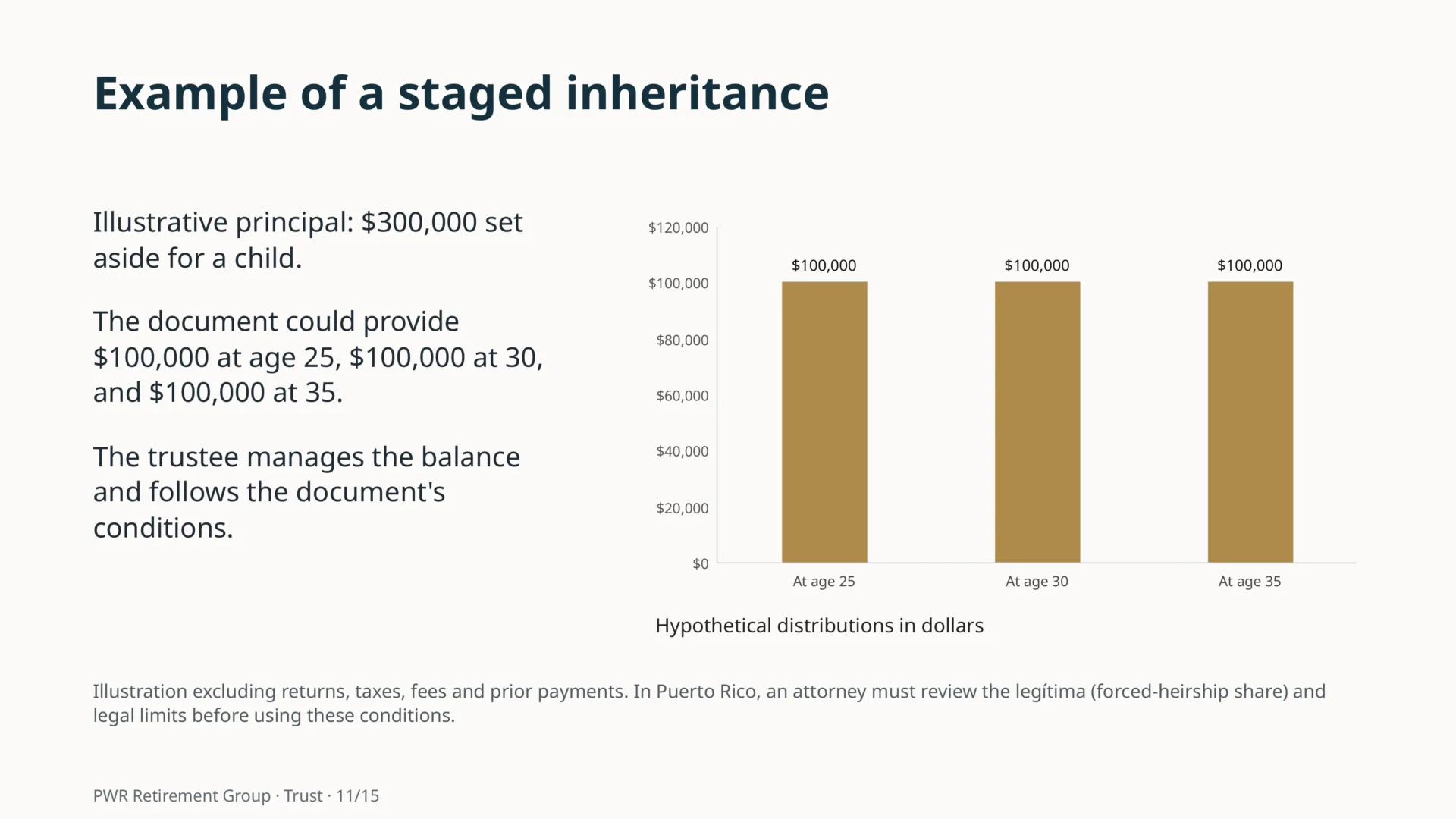
An illustrative $300,000 set aside for a child. The document could provide for distributions in stages rather than a single lump sum.

In the meantime, the trustee manages the balance and follows the document’s conditions.

Hypothetical distributions (USD)

Illustrative figures, excluding returns, taxes, fees and prior payments. In Puerto Rico, an attorney must review forced-heirship rules (legítima) and legal limits before using these conditions.

Trusts in Puerto Rico

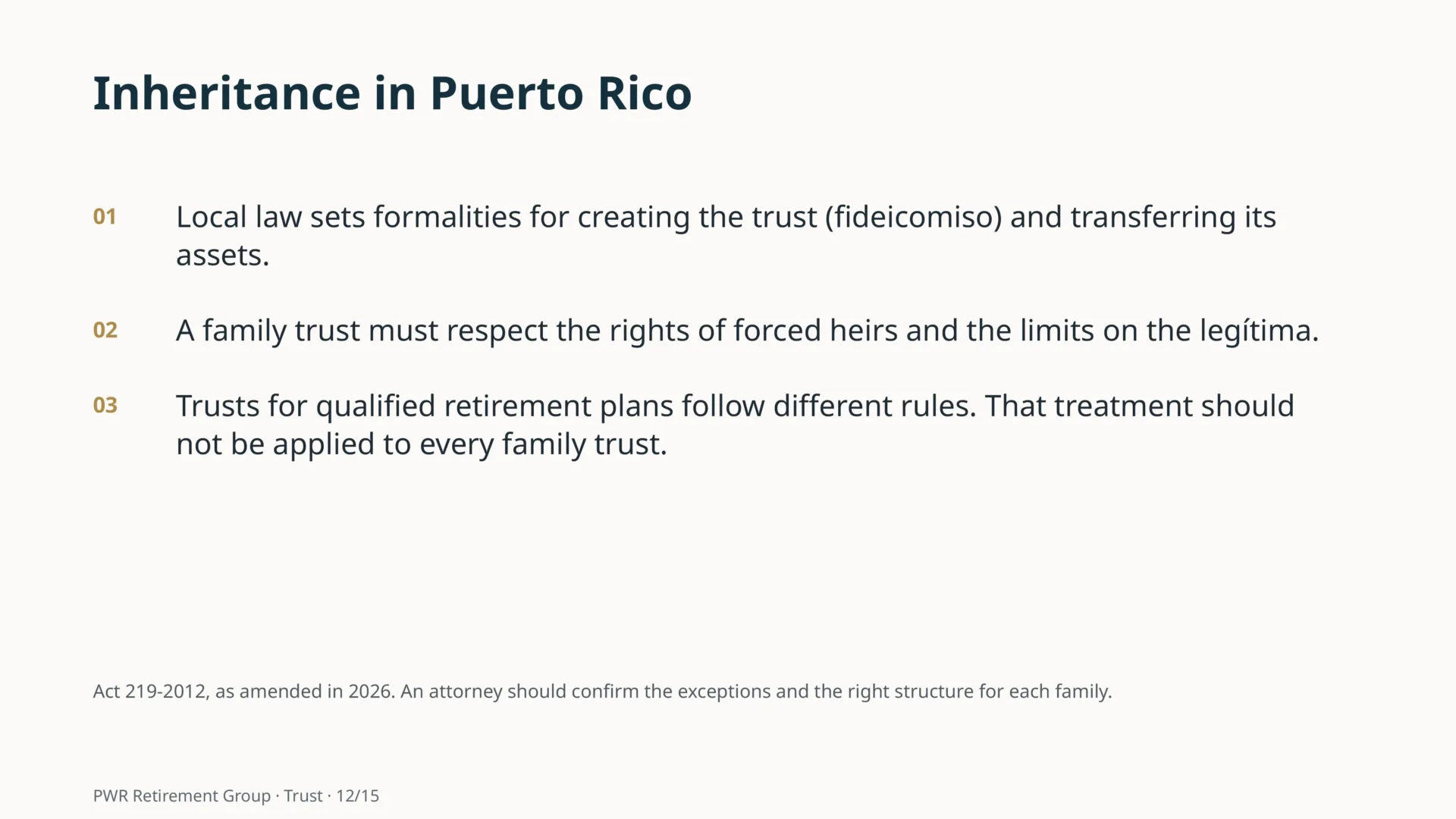
Inheritance in Puerto Rico

01

Local law sets formalities for creating a trust (fideicomiso) and transferring assets into it.

02

A family trust must respect the rights of forced heirs and the limits of the legítima (reserved portion).

03

Trusts for qualified retirement plans follow different rules. That treatment should not be assumed for every family trust.

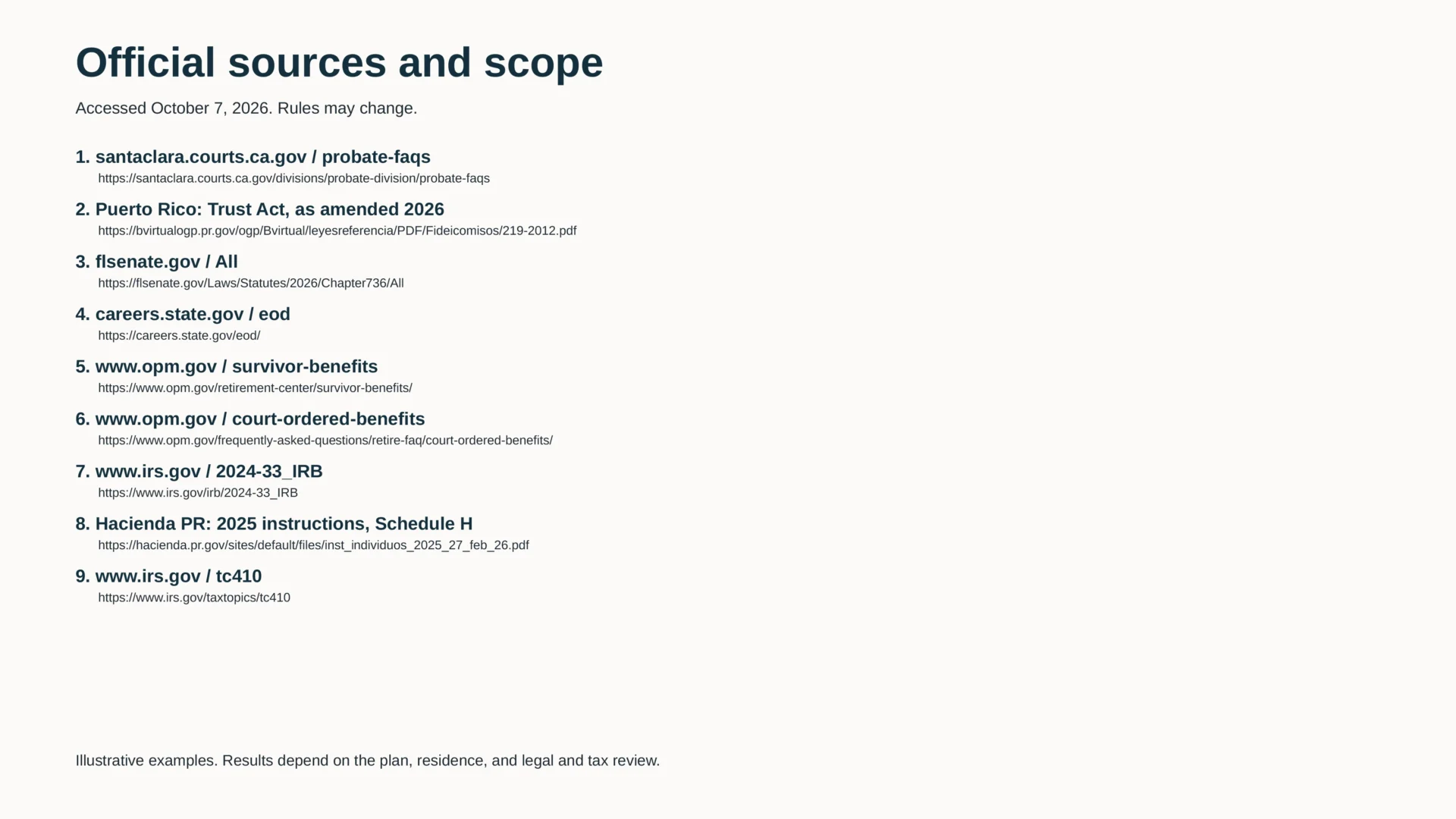
Act 219-2012, as amended in 2026. An attorney should confirm the exceptions and the right structure for each family.

For Federal Employees and Retirees

How a trust fits with your benefits

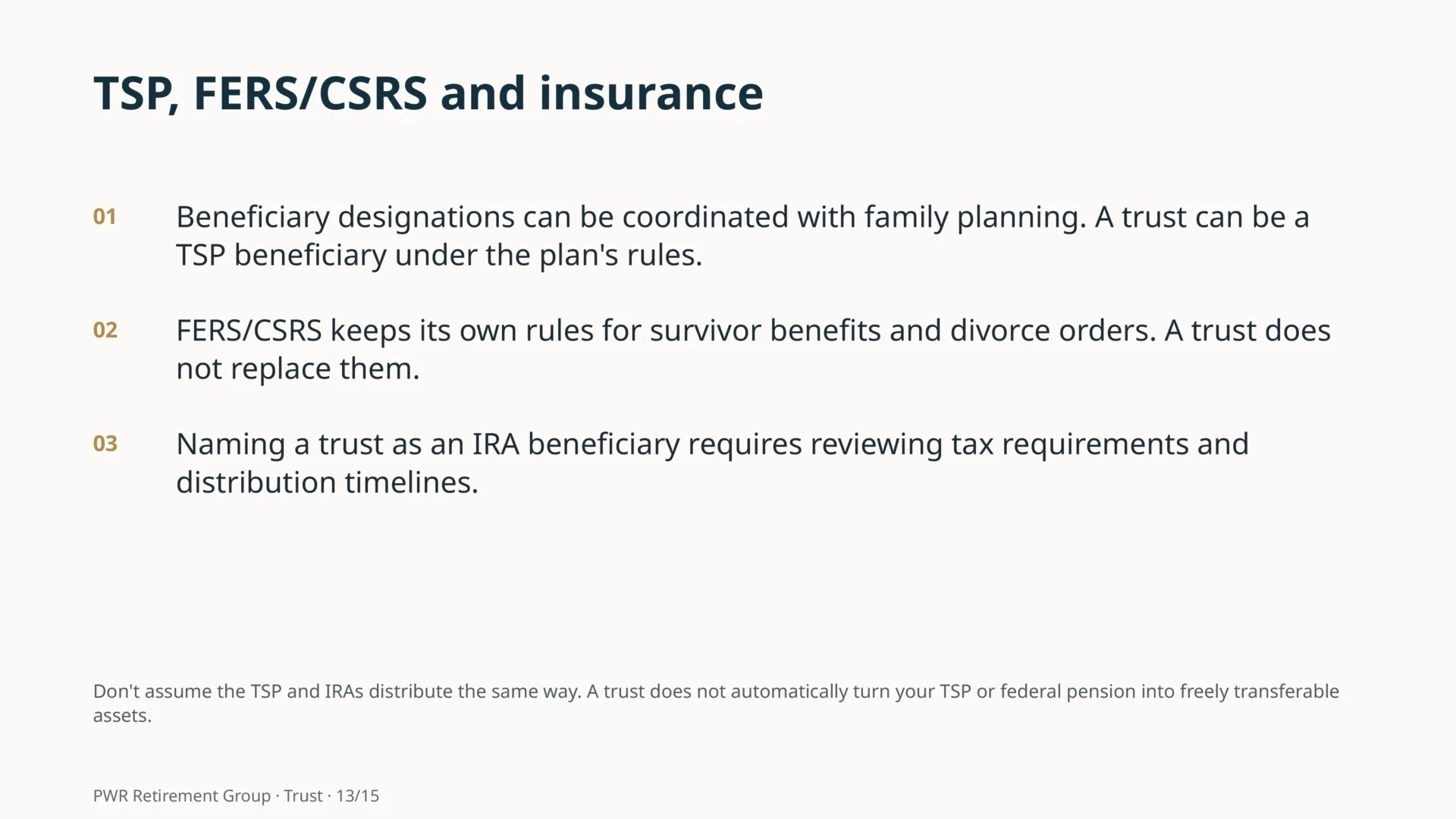
TSP, FERS/CSRS and insurance

  • 1

    Beneficiary designations can be coordinated with family planning. A trust can be named a TSP beneficiary under the plan’s rules.

  • 2

    FERS/CSRS keeps its own rules for survivor benefits and court orders in divorce. A trust does not replace them.

  • 3

    Naming a trust as an IRA beneficiary requires reviewing tax requirements and distribution timelines.

Don’t assume the TSP and IRAs distribute the same way. A trust does not automatically turn your TSP or federal pension into freely transferable assets.

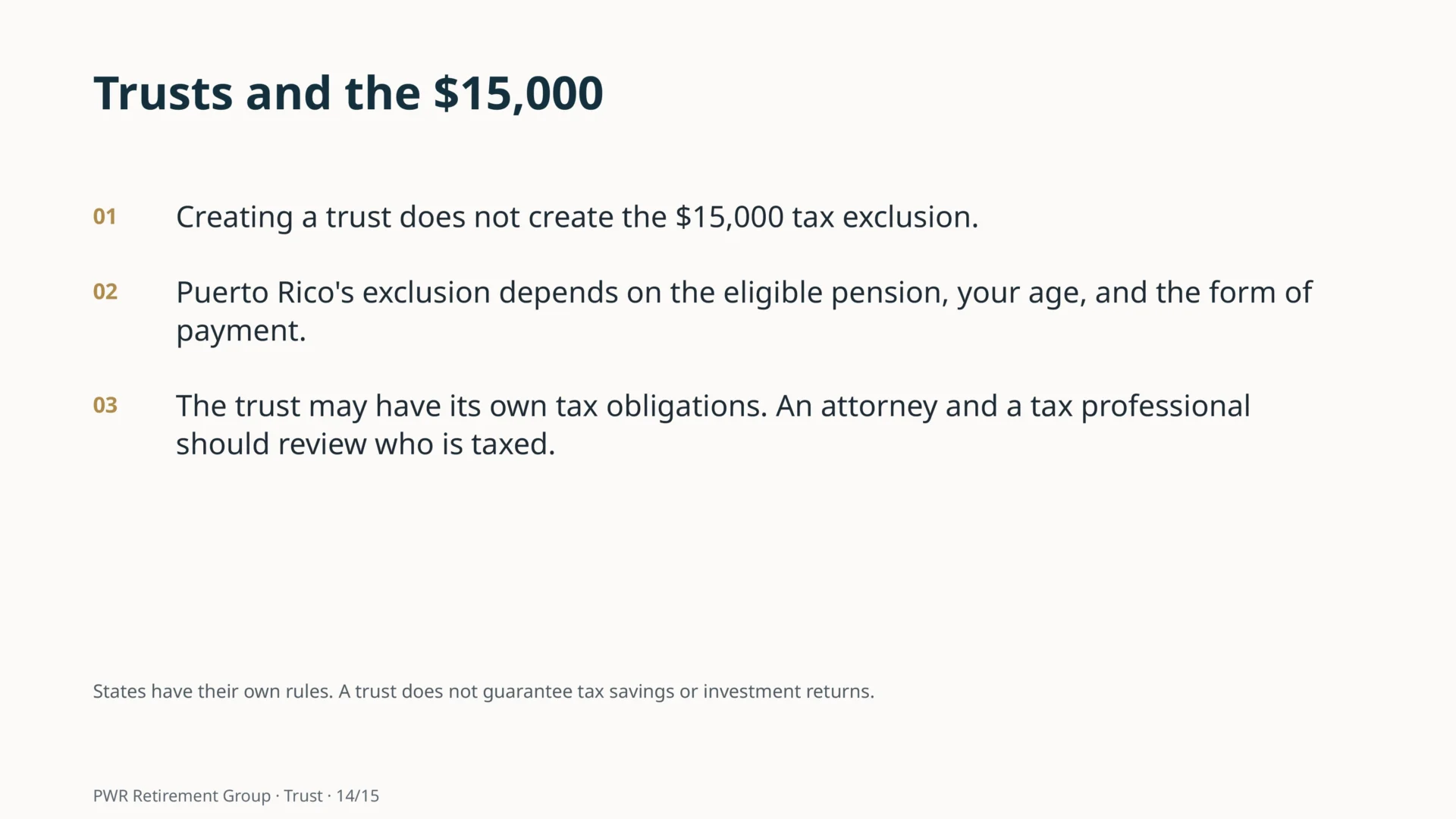
Trusts and the $15,000 exclusion

  • 1

    Creating a trust does not create the $15,000 tax exclusion.

  • 2

    Puerto Rico’s exclusion depends on the eligible pension, your age, and the form of payment.

  • 3

    The trust may have its own tax obligations. An attorney and a tax professional should review who is taxed.

States have their own rules. A trust does not guarantee tax savings or investment returns.

How We Help

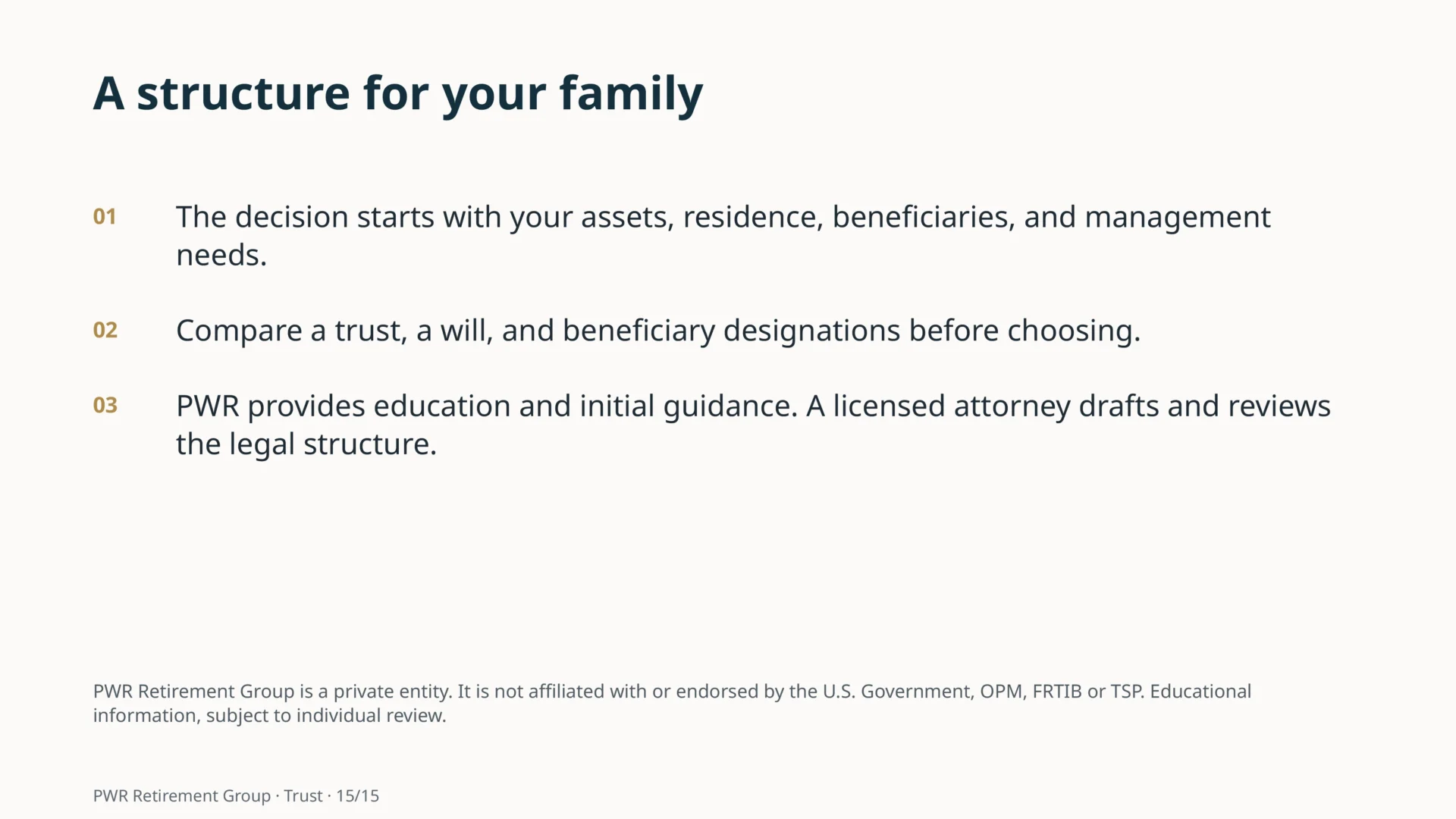
A structure built around your family

STEP 1

Your starting point

The decision starts with your assets, residence, beneficiaries, and management needs.

STEP 2

Compare your options

Compare a trust, a will, and beneficiary designations before choosing.

STEP 3

Education and legal structure

PWR provides education and initial guidance. A licensed attorney drafts and reviews the legal structure.

Frequently Asked Questions

What people ask us most

No. Assets must be legally transferred into the trust. Retirement accounts and their beneficiaries are reviewed separately.

Not necessarily. Protection depends on who contributed the assets, who can receive them, the access you keep, and the jurisdiction.

A trust can be a TSP beneficiary under the plan’s rules. FERS/CSRS survivor benefits keep their own rules.

No. That exclusion depends on the eligible pension, your age, and the form of payment, not on creating a trust.

Not on its own. A trust manages the assets placed in it; it does not create guaranteed returns or a new pension.

Organize your assets with clarity

Talk with a PWR educator about trusts, wills, and beneficiary designations before you make a decision.